


Social and Environmental Inequalities in Mainland France: An Analysis of Exposure to Heat, Air Pollution, and Lack of Vegetation
Environmental and social inequities in mainland France: an analysis of exposure to heat, air pollution, and lack of vegetation
Santé publique France in scientific journals
Sign up for our newsletter by filling out the form.
Exposure to environmental risk factors such as heat and air pollution, as well as the benefits associated with the development of green spaces, are major determinants of health. These exposures depend on the geographic context (rural, urban, land-use changes) and are interconnected through complex physical mechanisms (for example, vegetation affects air pollution and temperature, and vice versa). They can also have synergistic effects on health. Heat and air pollution are associated with an increased risk of mortality, morbidity, and adverse effects on perinatal health. Conversely, the presence of vegetation reduces the risk of mortality and is positively associated with perinatal health. The most disadvantaged populations, who are more exposed to these risks and structurally have less access to green spaces, are more severely affected, leading to environmental and social health inequalities.
Reducing exposure to heat and air pollution, and developing green spaces, are interventions that yield health benefits. They are part of an approach to promote health-promoting environments that are adapted to climate change, protect biodiversity, and facilitate the reduction of greenhouse gas emissions.
Understanding these exposures and cross-referencing them with social data is an essential step toward identifying and taking action in areas where multiple harmful exposures and social disadvantage overlap. The study conducted by Santé publique France and Inserm, published this month in the journal J Expo Sci Environ Epidemiol*, examined at the national level and on a fine geographic scale the accumulation of exposure to heat, air pollution, lack of vegetation, and social disadvantage from 2000 to 2018. This characterization of mainland France allows for the identification of the areas and populations most at risk and thus prioritized for the implementation of interventions.
3 questions for: Lucie Adélaïde**, Health, Environment, and Work Directorate, Santé publique France

Exposure to vegetation has numerous health benefits. Many studies have shown that people living in areas with more vegetation enjoy better mental, cardiovascular, and perinatal health. As a result, the WHO’s French Healthy Cities Network considers urban green spaces to be a tool for promoting health and equity.
The mechanisms through which vegetation affects health are not yet fully understood. Three primary pathways of action have been identified:
Reducing exposure to environmental stressors: air pollution, heat, noise, etc.
Contributing to capacity building by facilitating physical activity, social interaction, etc.
Restoring well-being through psychological recovery and stress reduction.
In line with the “One Health” approach, a fourth focus can be added: the protection of biodiversity.
Vegetation’s ability to reduce heat through shading and evapotranspiration makes it a central tool in climate change adaptation policies.
The effects of heat, air pollution, and vegetation on health are often studied independently. However, the existing interconnection between heat, vegetation, and air pollution raises the question of potential synergistic effects on health that remain poorly understood and under-researched.
A first step in studying these combined effects is the cross-analysis of these three exposures at a fine scale, over a long period of time, and across the entire national territory—something that had not been done until now. To do this, we created relative indicators that are comparable across all regions. This allows us to account for the diversity of climates and vegetation in France and to overcome the difficulty of using absolute temperature or NDVI (a satellite index measuring chlorophyll activity) values, which are difficult to compare across regions.
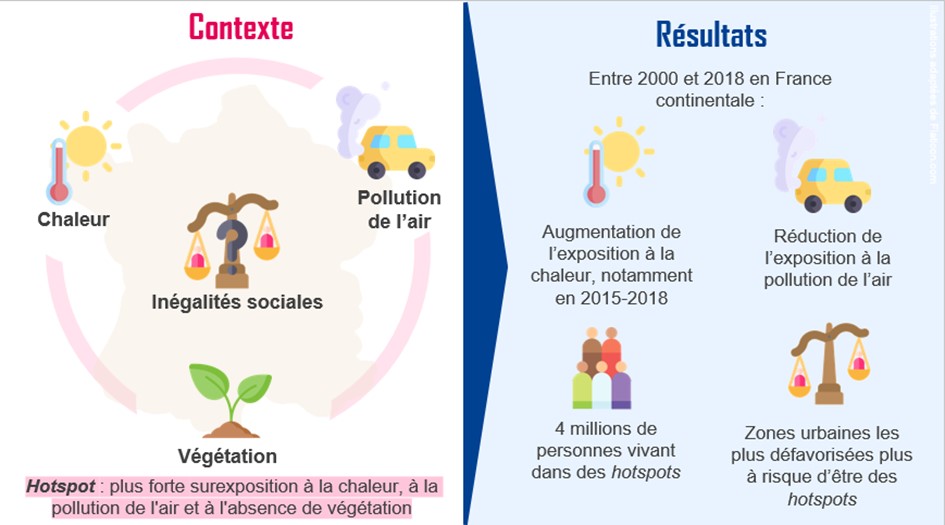
Defining these exposures has allowed us to identify environmental hotspots—areas with the highest cumulative overexposure to heat, air pollution, and lack of vegetation—and to study their association with social disadvantage.
This study highlights a higher level of heat exposure during the 2015–2018 period compared to the 2000–2014 period, which is consistent with the climate trends observed in France. Regarding ambient air pollution, although air quality improved between 2000 and 2018 for most pollutants, most of the urban areas studied remained above the WHO’s 2021 air quality guideline values in 2018. For example, 99.9% of urban areas had fine particulate matter (PM2.5) concentrations exceeding the guideline values. On average, 7% of the areas studied had the highest cumulative overexposure levels for the three factors examined (environmental hotspots). This percentage was similar in both rural and urban areas.
Finally, the most disadvantaged urban areas were at higher risk of being environmental hotspots. These results are not observed in rural areas, which can likely be explained by a more heterogeneous distribution of disadvantage and less granular spatial scales than in urban areas.
Source: J Expo Sci Environ Epidemiol - Design: Lucie Adelaïde
By examining the combined effects of heat exposure, lack of vegetation, and air pollution at the national level and in relation to social disadvantage, our findings align with the strategies outlined in the 2nd Climate Change Adaptation Plan and the 4th National Environmental Health Plan for addressing and integrating social inequalities into environmental health initiatives. This study encourages local stakeholders to address the issue of environmental justice in their adaptation policies by providing them with tools for inter-territorial comparisons at a fine spatial scale. This could, for example, enable the prioritization of certain territories experiencing higher cumulative exposures and greater social disadvantage, while taking into account local specificities and contexts.
With the upcoming release of data on data.gouv.fr, the environmental exposure indicators developed as part of this study will also be usable to examine the combined effects of temperature, air pollution, and vegetation on health, in relation to social inequalities. For example, we are studying the effects of heat, co-exposures (air pollution, vegetation), and social status on perinatal health, a major public health issue.
It is also important to note that the overseas departments and regions (DROM) could not be included in this study because the necessary data were not available, even though these territories are particularly vulnerable to climate change. Work is underway to assess the relevance and feasibility (availability and access to environmental data, etc.) of extending this study to the DROM.
This research addresses the need to develop knowledge for the implementation of equitable and just climate change adaptation.
* The version of the manuscript submitted for publication (not peer-reviewed) is available via open access on HAL: https://hal.science/hal-04444139
** This research was conducted as part of a thesis funded by Santé publique France, co-supervised by Santé publique France and Inserm, and affiliated with the Doctoral Network in Public Health coordinated by the École des hautes études en santé publique (EHESP).
Open Data and Data Availability
All exposure data collected at the IRIS and municipal levels and analyzed as part of this study is made available as open data.
It can also be obtained upon request from the authors.
These data at the municipal and IRIS levels were calculated using grid-based data (200 m² to 4 km²) derived from innovative exposure models covering the entire territory (1–3). These data are available upon request from the authors (johanna.lepeule@univ-grenoble-alpes.fr for PM and temperature data).
Hough, et al. Gaussian Markov Random Fields Improve Ensemble Predictions of Daily 1 km PM2.5 and PM10 across France. Atmospheric Environment (2021).
Hough, et al. A Multi-Resolution Air Temperature Model for France from MODIS and Landsat Thermal Data. Environmental Research (2020).
NO2 and O3 data were provided by INERIS.
Learn more about social inequalities in health and heat exposure:
Forceville, Gauthier, et al. “Spatial contrasts and temporal changes in fine-scale heat exposure and vulnerability in the Paris region.” Science of The Total Environment, vol. 906, January 2024, pp. 1674–76. ScienceDirect.
Health as a Lever for Action Against Climate Change – Symposium on April 8, 2022. Expert Insights - February 2023
National Climate Change Adaptation Plan (PNACC-2)
National Health-Environment Plan 4 (PNSE 4): "One Environment, One Health" (2021–2025)
Health in Action, March 2022, No. 459 Urban Planning for Health

Air
thematic dossier
Air pollution affects the entire population. The levels of pollutants found in the atmosphere are linked to health risks, and any reduction in exposure to these pollutants would be beneficial.

Extreme heat, heat wave
thematic dossier
Heat waves can have a significant impact on health. It is therefore essential to take proper precautions. Certain measures must be put in place, especially for those most at risk.












