


Surveillance of Kidney, Bladder, and Acute Leukemia Cancers in Adults in the Bouches-du-Rhône Department (REVELA13): Spatial Analyses, 2013–2016
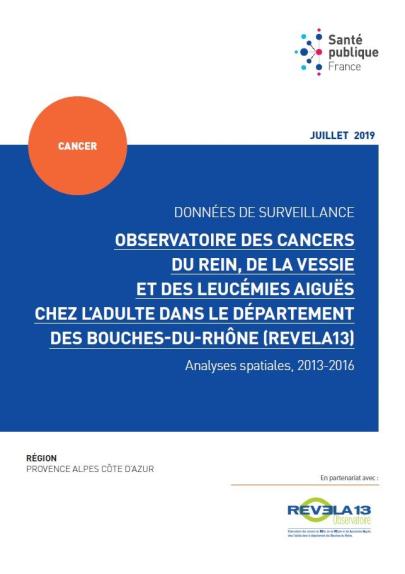
Since 2012, the REVELA13 Observatory has been recording new cases of kidney and bladder cancer, as well as acute leukemia in adults, in the Bouches-du-Rhône department, using three data sources: minutes from multidisciplinary team meetings, the hospital information system, and pathology reports. All cases are geolocated to the residential address at the time of diagnosis. This report presents the spatial distribution of new cases of these three targeted cancers, taking into account the influence of socioeconomic disadvantage and access to a specialist (urological cancers only). The primary objective is to identify, using various methods, the presence or absence of clusters of these cancers within the department, without any prior assumptions. The study was conducted over the years 2013–2016. At the departmental level, the estimated incidence of bladder cancer among individuals aged 20 and older was significantly higher than the national incidence for both sexes. Among men, an excess incidence of bladder cancer was identified in the southeastern part of the department, with two significant clusters: the first encompassing six districts of Marseille, and the second encompassing two districts of Marseille and 20 municipalities southeast of the city. Among women, no area with a localized excess incidence of bladder cancer was identified, which may be related to the small sample size. However, a significant cluster, including nine districts of Marseille and one municipality located east of the city, was identified. The differences in geographic distribution observed at the municipal level were not explained by socioeconomic disadvantage among men and women. However, this distribution was linked to access to a urologist for women. The estimated departmental incidences of kidney cancer and acute myeloid leukemias among people aged 20 and older were not different from the national incidences for both sexes. Incidence rates of kidney cancer were distributed evenly across the region, and no clusters were identified. The same results were observed for acute myeloid leukemias. These results were based on a small number of cases and will need to be confirmed with a larger sample size, requiring a longer data collection period. The convergence of results obtained using different methods and their consistency with those in the literature are encouraging for the continuation of this study. These results have met the objectives defined when REVELA13 was established and provide initial insights at the population level. However, they must be confirmed by additional spatial analyses, particularly at the Iris level, to identify potential clusters within a municipality. These results may be supplemented by other studies to formulate hypotheses regarding exposure factors associated with the identified clusters.
Author(s): Mantey Karine, Pascal Laurence, Cortaredona Sébastien
Publishing year: 2019
Pages: 80 p.
Collection: Monitoring data
In relation to
Our latest news

news
Growing Up with Screens. A special report in *La Santé en action* No. 474,...

news
Seniors, pregnant women, and nursing home staff: What is the status of their...

news












