


Post-Fire Health Study 76. A study focused on your health. An epidemiological questionnaire-based study following the industrial fire on September 26, 2019, in Rouen (France). Results of the supplementary module on mental health
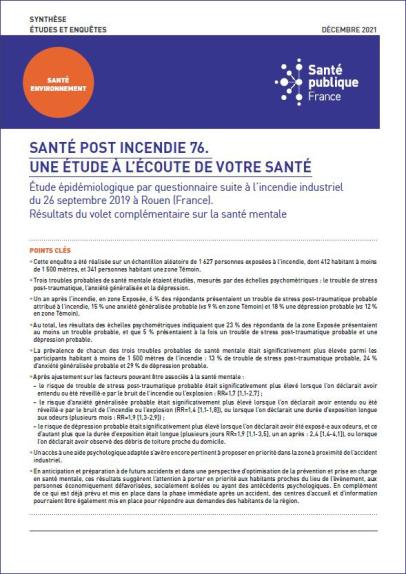
This survey was conducted on a random sample of 1,627 people exposed to the fire, including 412 living within 1,500 meters, and 341 people living in a control area. Three probable mental health disorders were studied, measured using psychometric scales: post-traumatic stress disorder, generalized anxiety, and depression. One year after the fire, in the Exposed area, 6% of respondents had a probable post-traumatic stress disorder attributed to the fire, 15% had probable generalized anxiety (vs. 9% in the Control area), and 18% had probable depression (vs. 12% in the Control area). Overall, the results of the psychometric scales indicated that 23% of respondents in the Exposed zone had at least one probable disorder, and that 5% had both probable post-traumatic stress disorder and probable depression. The prevalence of each of the three probable mental health disorders was significantly higher among participants living within 1,500 meters of the fire: 13% for probable post-traumatic stress disorder, 24% for probable generalized anxiety, and 29% for probable depression. After adjusting for factors potentially associated with mental health: the risk of probable post-traumatic stress disorder was significantly higher among those who reported hearing or being awakened by the noise of the fire or the explosion: RR=1.7 [1.1–2.7]; the risk of probable generalized anxiety was significantly higher among those who reported hearing or being awakened by the noise of the fire or explosion (RR=1.4 [1.1–1.8]), or among those reporting prolonged exposure to odors (several months: RR=1.9 [1.3-2.9]); the risk of probable depression was significantly higher among those who reported exposure to odors, and this risk increased with longer exposure duration (several days: RR=1.9 [1.1-3.5], one year later: 2.4 [1.4–4.1]), or when reporting having observed debris from nearby roofs. Access to appropriate psychological support remains a priority to offer in the area surrounding the industrial accident. In anticipation of and preparation for future accidents, and with a view to optimizing prevention and mental health care, these results suggest that priority attention should be given to residents living near the site of the incident, as well as to economically disadvantaged individuals, those who are socially isolated, or those with a history of mental health issues. In addition to what is already planned and implemented in the immediate aftermath of an accident, reception and information centers could also be established to address the needs of local residents.
Author(s): Morel Pauline, El Haddad Maria, Perrine Anne-Laure, Empereur-Bissonnet Pascal, Richard Jean-Baptiste, Golliot Franck, Saoudi Abdessattar, Zeghnoun Abdelkrim, Blanchard Myriam, Le Lay Emmanuelle, Pedrono Gaelle, Motreff Yvon
Publishing year: 2021
Pages: 24 p.
Collection: Studies and Surveys
In relation to
Our latest news

news
Shamonda Virus: First Human Case Detected in France—What Do We Know?

news
Call for Nominations for the Renewal of the Scientific Advisory Board of the...

news












