


World Alcohol Awareness Day: First National Estimates of Alcohol-Related Harm and a National Campaign
cp-saf2018.pdf
Download (PDF - 355.12 KB)
In observance of World Fetal Alcohol Syndrome Awareness Day, which will be held on September 9, Santé publique France:
publishes, for the first time, a national estimate of fetal alcohol spectrum disorders diagnosed in newborns;
presents the results of the 2017 Health Barometer on alcohol consumption during pregnancy;
is launching a one-month national information campaign in the press and online starting September 9, targeting both the general public and healthcare professionals: any alcohol consumption during pregnancy is likely to pose a risk, necessitating the precautionary principle of "zero alcohol during pregnancy." This campaign is being rolled out in the French overseas departments.
Drinking alcohol during pregnancy is toxic to the fetus and can lead to various complications (growth retardation, damage to the central nervous system, birth defects, etc.), of which fetal alcohol syndrome is the most severe form. Alcohol consumption during pregnancy is the leading cause of non-genetic mental disability and social maladjustment in children in France. Current scientific knowledge does not allow for the establishment of a safe threshold for alcohol consumption below which there would be no risk to the baby. Therefore, health authorities recommend, as a precautionary measure, abstaining from all alcoholic beverages during pregnancy.
Fetal Alcohol Spectrum Disorders: Initial Estimates in France
Despite the health and social impact of these disorders, no national estimates or recent regional comparisons were available until now. The study¹ conducted by Santé publique France made it possible for the first time to measure the frequency of FAS cases and other consequences of fetal alcohol exposure among children hospitalized during their first month of life at the national and regional levels.
Thus, in France, between 2006 and 2013, 3,207 newborns (equivalent to one birth per day) presented with at least one consequence related to fetal alcohol exposure, including 452 of them (equivalent to one birth per week) with fetal alcohol syndrome (FAS).
These figures are underestimated given the difficulty in diagnosing these disorders during the neonatal period and do not include diagnoses made at a later stage. However, they help to better characterize the burden posed by fetal alcohol exposure.
Pregnancy and Alcohol: Occasional Consumption Still Too Common
According to data from the 2017 Health Barometer² published by Santé publique France, alcohol consumption during pregnancy is not uncommon in France. Indeed, among the women surveyed—who were either pregnant at the time of the survey or mothers of a child under 5 years of age:
Nearly 6 out of 10 women reported having been informed of the risks of alcohol consumption by the doctor or midwife who was or had been caring for them
1 in 10 reported having consumed alcohol occasionally during her pregnancy.
Although lower than in 2010 (2 in 10 women according to the results of the National Perinatal Survey), this proportion remains significant since it could have affected nearly 90,000 births.
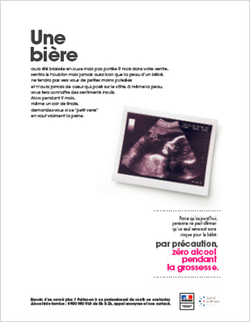
An information campaign reiterating the precautionary principle
Starting September 9 and continuing throughout the month, Santé publique France is launching a major information campaign based on offline media targeting women of childbearing age, supplemented by a digital influencer campaign.
The media campaign aims to promote the precautionary principle, with a particular focus on occasional alcohol consumption during pregnancy. The message is educational, transparent, and accessible: "Because today no one can say for certain that even a single drink is risk-free for the baby: as a precaution, zero alcohol during pregnancy." It will be featured in women’s, parenting, and celebrity magazines, as well as in free daily newspapers in mainland France, and on billboards in the overseas departments.
For overseas territories, Santé publique France is bolstering the media campaign by providing local radio stations with ready-to-air segments.
The digital component complements this initiative with a highlight on September 9 and a continuous theme throughout the month. Three web influencers will use videos to provide concrete examples of abstinence during pregnancy and suggest avoidance strategies to use.
Healthcare professionals will play a key role in relaying this message, as they are major players in informing pregnant women and their families about the dangers of alcohol and emphasizing the "zero alcohol during pregnancy" recommendation. To support them in their work, informational materials (posters and brochures) will be made available to the public in healthcare professionals’ waiting rooms.
Alcool Info Service, the Santé publique France website, answers all questions
Women with questions about alcohol consumption during pregnancy can turn to the Alcool Info Service remote assistance program (phone and internet). It offers them 7 days a week:
support and guidance from professionals experienced in this field.
a "Alcohol & Pregnancy" section on the website http://www.alcool-info-service.fr/alcool-et-vous/alcool-grossesse/enceinte-boire-alcool, which provides clear, easy-to-understand recommendations and practical help through articles and educational videos in case of difficulties.
a directory to help you find the nearest specialized support center: http://www.alcool-info-service.fr/alcool-et-vous/alcool-grossesse/accueil
For more information:
Andler R, Cogordan C, Richard JB, Demiguel V, Regnault N, Guignard R, Pasquereau A, Nguyen-Thanh V. 2017 Health Barometer. Alcohol and tobacco use during pregnancy. Saint-Maurice: Santé publique France; 2018. 10 p.
Laporal S, Demiguel V, Cogordan C, Barry Y, Guseva Canu I, Goulet V, Regnault N. Surveillance of fetal alcohol spectrum disorders: analysis of data from the medical information systems program in France between 2006 and 2013. Summary. Saint-Maurice: Santé publique France: 2018. 16 p.
1Identification of fetal alcohol spectrum disorders during the neonatal period using medical-administrative databases. Feasibility study based on data from the Program for the Medicalization of Information Systems in France between 2006 and 2013.2Telephone survey conducted from January 5 to July 18, 2017, among a representative sample of the population aged 18 to 75 – The section on alcohol and tobacco use during pregnancy was conducted among 1,614 mothers of children aged five or younger included in the survey and 186 pregnant women.
Our latest news

news
Growing Up with Screens. A special report in *La Santé en action* No. 474,...

news
Seniors, pregnant women, and nursing home staff: What is the status of their...

news












