


Sun-Related Risks and Cancer: An Analysis of French People’s Habits and Knowledge
cp-risque-solaire-160718.pdf
Download (PDF - 453.05 KB)
Since 1996, public authorities have conducted annual sun safety campaigns. Today, while the main safety guidelines are well known, they are not always followed, and misconceptions continue to circulate. Santé publique France and the National Cancer Institute are releasing the 2015 Cancer Barometer today,1 which focuses on the risks associated with exposure to natural and artificial UV radiation. This marks an opportunity to remind the public, through an information campaign running throughout July, that the sun is not without danger and that a few simple habits can help protect against it and preserve one’s health.According to data from the 2015 Cancer Barometer, while 9 out of 10 people believe that sun exposure is a likely cause of skin cancer, their protective behaviors still need improvement: Generally speaking, people with fair skin are more likely to protect themselves from the sun than those with darker skin.Parents of children under 4 are more diligent about sun protection measures for their children but tend to be more lax when it comes to themselves: Sun exposure is not limited to vacation destinations; it can also occur in one’s own backyard, during outdoor activities, at school, and even at work. Thus, for the first time, the Cancer Barometer examined sun exposure in the workplace: The systematic or frequent use of preventive measures at work is closely linked to those used outside of work.
Sun Safety: Preventive Measures Still Not Widely Practiced
Nearly 3 out of 4 people report getting a sunburn during their first exposure;
the most common protective measure is wearing sunglasses (70%), followed by avoiding the sunniest hours (69%) and wearing a T-shirt (61%);
only 4 out of 10 people apply sunscreen every two hours;
these behaviors are, moreover, far from systematic.
Misconceptions that are still all too common
47% of the population believes that if childhood sunburns are properly treated, they have no consequences in adulthood. This opinion has risen by 9 percentage points over the past 10 years. Forty percent held this view in 2010, and 38% in 2005; yet sunburns sustained during childhood significantly increase the risk of skin cancer in adulthood and cause eye damage that can lead to serious vision problems;
24% believe that using artificial UV rays before a vacation helps prepare the skin to protect itself from the sun; however, artificial tanning does not provide the same protective effect as natural tanning: it does not result in thickening of the skin. Far from preparing the skin for the sun, artificial UV rays—which are also carcinogenic—simply add to the sun’s UV rays and amplify their carcinogenic effect;
21% believe that sunburn prepares the skin by making it less vulnerable to the sun; however, sunburn is a skin burn;
10% believe that applying sunscreen just once is enough to protect them for the day, yet it must be reapplied every two hours to maintain effective protection.
Children are better protected than adults
Thus, 78% of parents make sure their children always wear a hat, but only 13% do the same for themselves;
Exposure between noon and 4 p.m. is consistently avoided for 62% of children but only for 20% of parents;
Finally, sunscreen is reapplied every two hours for 54% of children, while only 15% of parents do the same for themselves.
Sun-related risks do not affect only vacationers
More than one in five working adults report having to work often or consistently in the sun;
54% of workers exposed to the sun while working can move into the shade on a sunny day, and 37% can avoid being in the sun between noon and 4 p.m.
Regarding personal protection, 75% of workers wear a T-shirt, followed by 47% who wear sunglasses and 39% who wear a hat or cap. Only 13% of those surveyed say they apply sunscreen every two hours.
An information campaign to raise awareness about sun protection and prevent skin cancer
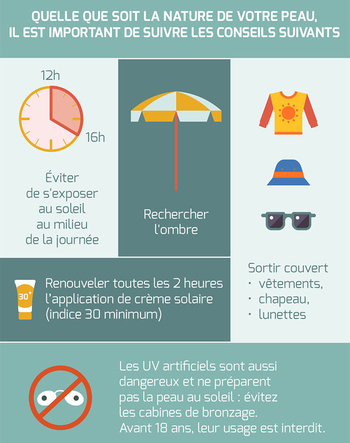
The National Cancer Institute and Santé publique France are rolling out a digital information campaign throughout July to raise awareness, primarily among parents of young children, about UV exposure.This campaign uses an infographic to highlight the four essential steps for preventing sun exposure: avoid being out between noon and 4 p.m. and seek shade, always protect children’s skin, cover up by wearing a T-shirt, sunglasses, and a hat, and apply sunscreen generously every two hours.
These prevention tips are also essential for people exposed to the sun as part of their jobs—such as farmers, construction workers, sailors, and anyone working outdoors or engaging in outdoor leisure activities. The infographic also offers practical advice for those participating in sports and outdoor activities.
Skin Cancers
The incidence of skin cancer has been steadily increasing for the past 30 years.
Exposure to sunlight is the main cause of skin cancer. There are two main types:
Carcinomas are the most common type of skin cancer. They generally occur after the age of 50, on exposed areas of the body (face, neck, shoulders, forearms, legs, etc.). They are most often caused by excessive and chronic sun exposure.
Skin melanoma is much rarer than carcinoma but is the most serious form of skin cancer due to its "high metastatic potential," meaning its ability to spread rapidly to other parts of the body.
Treatments for skin cancers are all the more effective when detected early. The infographic also outlines the main signs for recognizing melanoma.
To raise awareness and remind the public of key sun safety measures, Santé publique France has made the website www.prevention-soleil.fr available to the general public; you can also find the National Cancer Institute’s information packet here.
View the full infographic
1 Survey conducted among a representative sample of the population consisting of 3,931 people aged 15 to 75.
Our latest news

news
Shamonda Virus: First Human Case Detected in France—What Do We Know?

news
Call for Nominations for the Renewal of the Scientific Advisory Board of the...

news












