


Significant excess mortality among immigrant populations during the first wave of the COVID-19 pandemic in France
cp_ined_081122.pdf
Download (PDF - 1.07 MB)
Press Contacts
INED
service-presse@ined.fr
Gilles GARROUSTE - Institutional Communications Officer - Tel.: 01 56 06 57 04
Christina LIONNET - Director of Communications - Tel.: 01 56 06 57 28
Inserm
presse@inserm.fr
Santé publique France
presse@santepubliquefrance.fr
In a study conducted by INED and Inserm in partnership with Santé publique France and the Institut Convergences Migrations, researchers¹ found that the excess mortality observed at the start of the COVID-19 pandemic, between March 18 and May 19, 2020, was significantly higher among various foreign-born populations than among the French-born population. The results are published in the journal Social Science and Medicine.
Excess mortality up to 9 times higher among immigrants
Before the COVID-19 pandemic, between 2016 and 2019, mortality rates among immigrant populations (excluding those from Eastern Europe) were lower than those of the population born in France (see Figure 1). This phenomenon is typically observed in major immigration countries around the world.² During the first wave of the pandemic in the spring of 2020, excess mortality among immigrant populations was significantly higher than among those born in France.
The gap is visible among those aged 70 and older, and it is even more pronounced among those aged 40 to 69. For example, within the 40–69 age group, excess mortality rates were, in the regions most affected by the pandemic (Grand-Est and Île-de-France), 8 to 9 times higher for immigrants from Sub-Saharan Africa and 3 to 4 times higher for those from North Africa, the Americas, Asia, or Oceania than for the French-born population. Due to this disparity in the rise in deaths at the onset of the pandemic, the overall mortality rates of immigrants born outside Europe—which are usually lower than those of people born in France—were significantly higher during the first wave. The impact of this first wave of the COVID-19 pandemic thus caused an unprecedented disruption in the usual mortality patterns of these population groups.
Multiple explanatory factors
During the first wave of COVID-19, the strict lockdown implemented by the authorities helped contain the pandemic’s impact on the healthcare system, in terms of hospitalizations and mortality.
However, this period was also accompanied by significant disparities in exposure to the virus among different populations. In this context, the factors explaining the specific vulnerability of immigrant populations and the magnitude of excess mortality before age 70 could be multiple and cumulative, reflecting social health inequalities due to:
environmental and living conditions (population density in residential areas, household density) and working conditions (“essential” jobs that cannot be performed remotely, commuting via public transportation), which increase the risk of infection; and
difficulties in accessing care and receiving treatment in a context of hospital overcrowding.
In the event of a new pandemic, the results of this study call for particular attention to be paid to people’s living conditions, as well as to prevention, access to the healthcare system, and care for the most vulnerable.
Figure 1 – Standardized overall mortality rates for people aged 40 and older. Years 2016–2019 (left panel) and weeks 12–20 of the years 2016–2020 (right panel), by country of birth. Metropolitan France
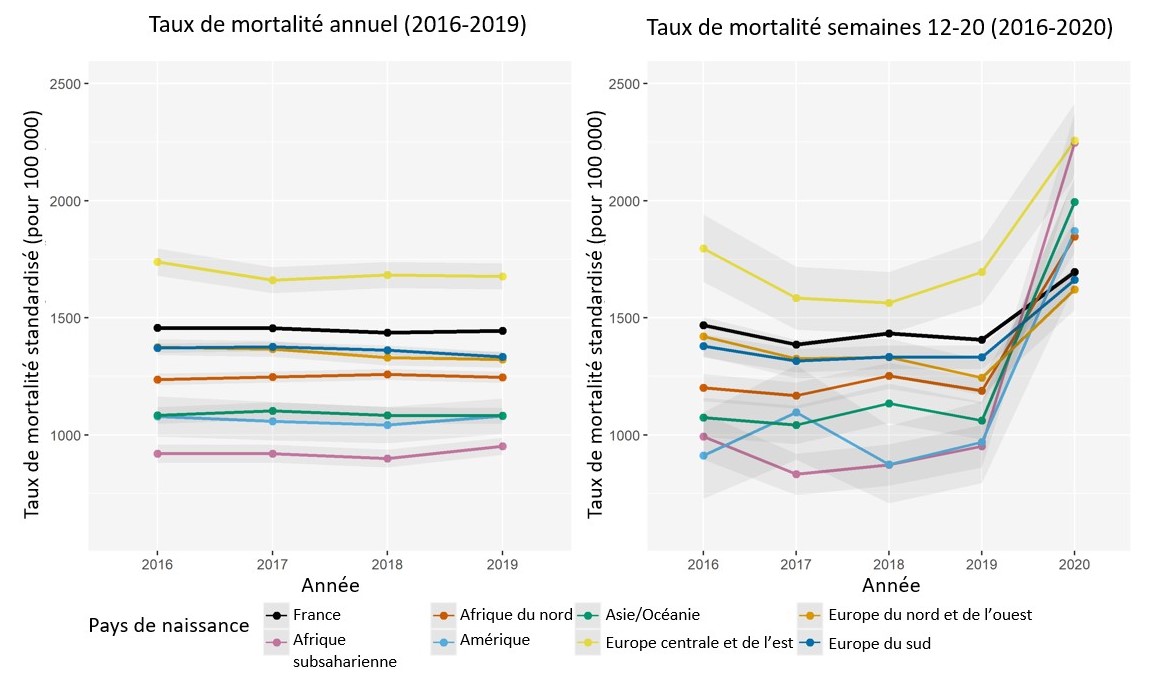
Data: Deaths: provisional data from death certificates (Form B7 bis) released by INSEE
For more information:
The article is available at the following link:
This article was published in a scientific journal indexed by evaluation bodies.
About INED:
The National Institute for Demographic Studies (INED) is a public research organization specializing in the study of populations, and a partner to academia and the research community at both the national and international levels. The institute’s mission is to study the populations of France and other countries, to widely disseminate the knowledge it generates, and to contribute to training in and through research. Through an open approach to demography, it draws on a wide range of disciplines, including economics, history, geography, sociology, anthropology, statistics, biology, and epidemiology. With its 10 research units and 2 joint service units, it fosters collaboration and leads numerous European and international research projects.
About Inserm:
Founded in 1964, Inserm is a public scientific and technological institution under the joint supervision of the Ministry of Health and the Ministry of Research. Dedicated to biological, medical, and human health research, it spans the entire spectrum from the research laboratory to the patient’s bedside. On the international stage, it partners with leading institutions engaged in the scientific challenges and advancements in these fields.
About Santé publique France:
Santé publique France addresses the need for a center of reference and expertise in public health in France. Based on the continuum between knowledge and intervention, our mission is to improve and protect the health of the population. Our work addresses major public health challenges over the long term, in the areas of protection against threats (including infectious risks, environmental risks, etc.) on the one hand, and health improvement (health determinants, prevention, health promotion, and reducing the burden of chronic diseases, social and regional inequalities, etc.) on the other. Santé Publique France is a public institution under the supervision of the Ministry of Health and Prevention.
[1] Myriam KHLAT (INED), Walid GHOSN (INSERM), Michel GUILLOT (INED | University of Pennsylvania), Stéphanie VANDENTORREN (Santé publique France), DcCOVMIG Research Team
[2] The lower mortality rates observed among many immigrant populations are unexpected given their disadvantaged economic situation. The primary explanation put forward in the scientific literature is that migrants are generally in better health than the general population of their country of origin, and often even in better health than the population of their host country, at least at the time of their arrival. This selection process is known as the “healthy migrant effect.”
Stay informed about the COVID-19 pandemic in France and around the world
Updates, Q&As, expert interviews... everything you need to know about the novel coronavirus (SARS-CoV-2) and COVID-19 in France and around the world
Our latest news

news
Growing Up with Screens. A special report in *La Santé en action* No. 474,...

news
Seniors, pregnant women, and nursing home staff: What is the status of their...

news












