


COVID-19 Epidemiological Update for September 24: The epidemic situation is worsening; all indicators are on the rise
CP_pe_covid_240920.pdf
Download (PDF - 585.22 KB)
Press Contacts
Santé publique France
presse@santepubliquefrance.fr
Stéphanie Champion: 01 41 79 67 48
Marie Delibéros: 01 41 79 69 61
Camille Le Hyaric: 01 41 79 68 64
Published weekly, the epidemiological update on COVID-19 surveillance provides a detailed analysis of the various indicators established by Santé publique France and its partners to track the progression of the epidemic and guide public policy decisions. The epidemiological update of September 24 confirms an upward trend in all indicators used to monitor the epidemic, albeit at different rates. The number of confirmed cases is rising less sharply than visits to emergency rooms, hospitalizations, or admissions to intensive care units, for example. This likely underestimation of new cases—due to laboratory backlogs and longer turnaround times for results—has led Santé publique France to include a new reproduction rate, or effective R, based on hospitalizations in this report, to better assess the dynamics of the epidemic.
The outbreak is intensifying; prevention must be both individual and collective
In Week 38, in mainland France, viral circulation continued to rise, leading to a worsening of the situation, particularly regarding hospitalizations and deaths. The number of new hospitalizations increased by 34% between Week 37 (2,464 hospitalizations) and Week 38 (3,657). The rise in new ICU admissions is even steeper: a 40% increase in Week 38 (599 vs. 427). The number of COVID-19-related deaths (including deaths in hospitals and deaths in nursing homes and other long-term care facilities) rose from 265 in Week 37 to 332 in Week 38, a 25% increase.
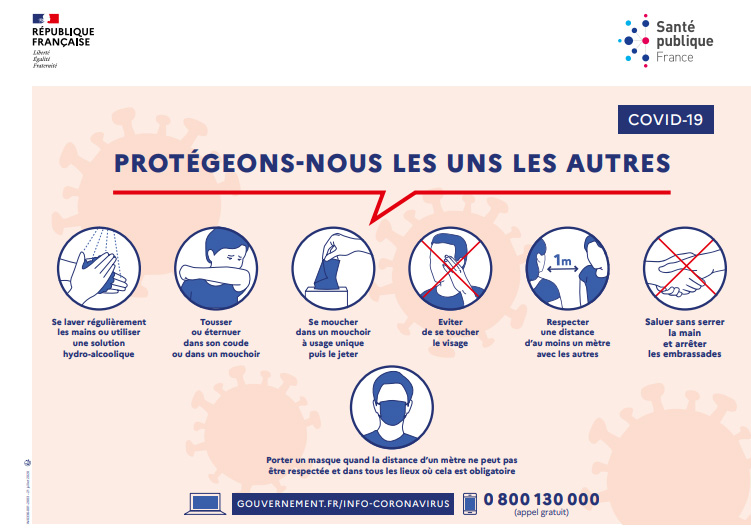
In the absence of a cure or vaccine, preventive measures (hygiene, physical distancing, reducing contact, and proper mask-wearing (see the tutorial)) are our only defenses. Protecting yourself also means protecting others.
An additional indicator for assessing the dynamics of the epidemic
The effective reproduction number (or Reff) is useful for analyzing the dynamics of virus transmission during an epidemic. It can be calculated using various data points: the number of cases, the number of emergency room visits, and the number of hospitalizations. When Reff is significantly greater than 1, the epidemic is spreading.
Through week 37, the epidemiological update included two types of Reff. The first was calculated based on the number of confirmed cases in France (virological data, SI-DEP), the SI-DEP Reff; the second was calculated based on emergency department visit data (OSCOUR®), the OSCOUR® Reff.
The interpretation of the effective R should be considered in conjunction with all other indicators. Currently, the strain on testing resources (testing capacity and delays in reporting results) calls for caution in interpreting the Reff SI-DEP (1.06), which is likely underestimated. This is why, starting this week, the effective R is also being calculated using hospitalization data for COVID-19 cases (SI-VIC data): the SI-VIC effective R (1.28).
Learn more: What is R, or the virus reproduction number?
Which Reff should be used?
The SI-DEP Reff is the one that, in theory, allows for the most responsive tracking of the epidemic’s dynamics; it depends on testing capacity. The OSCOUR® and SI-VIC Reffs describe trends with a longer lag. The OSCOUR® Reff is based on visits to emergency departments by suspected COVID-19 cases, which are therefore unconfirmed. The SI-VIC Reff has the longest lag but is theoretically the most stable.
The OSCOUR® and SI-VIC indicators are the ones to monitor as a priority in the coming weeks.
Daily Data vs. Consolidated Data: Key Insights
Where does the data come from? Every day, Santé publique France teams receive a vast amount of data from a network of numerous partners. This information is gradually consolidated over a period ranging from a few hours to several days. However, to obtain the most accurate picture possible of the epidemic’s progression, Santé publique France analyzes this data at various points after its receipt.
Daily analyses (upon receipt of the data) provide early information on epidemic trends. They also help alert surveillance teams to the occurrence of an unusual event. This event is then investigated to determine whether it is related to system operations (such as weekend catch-up processing) or whether it constitutes a warning sign.
Analyses following data consolidation are produced several days or even weeks after receipt. This delay allows partners time to report all data and surveillance teams to validate it. The analysis then provides more comprehensive and accurate information. It enables the monitoring of an epidemic as closely as possible to reality.
For example, in the context of SI-VIC surveillance, data comes from healthcare facilities. Between the admission of a patient suspected of having COVID-19 to a healthcare facility and their inclusion in the analyses, several steps are required: confirmation of the diagnosis by the facility’s physicians, transmission of the information to the data entry staff, entry into the SI-VIC database, transmission of the database to Santé publique France, followed by the data investigation and validation stages. The time between each step can vary depending on the situation and the facility. It is important to analyze and communicate the data as soon as it is received—even if it is potentially incomplete and subject to significant variations—as well as after it has been consolidated.
Find:
Key figures on the COVID-19 pandemic and its progression in France and around the world, along with a map showing the vulnerability of departments: here
Daily updated indicators on the Géodes mapping observatory.
Our latest news

news
Shamonda Virus: First Human Case Detected in France—What Do We Know?

news
Call for Nominations for the Renewal of the Scientific Advisory Board of the...

news












