


Colorectal cancer: 18,000 deaths per year
cp-cancer-colorectal-150218.pdf
Download (PDF - 500.19 KB)
An effective test is available: it is important for women and men aged 50 to 74 to participate in screening
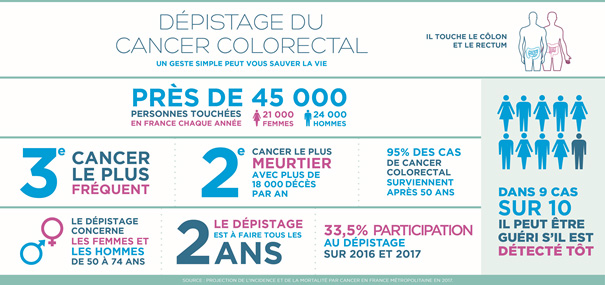
With nearly 45,000 new cases and 18,000 deaths per year, colorectal cancer remains the second deadliest cancer. Despite a test that has proven its reliability and effectiveness in detecting early-stage cancers and precancerous lesions, participation among the target population for organized screening (women and men aged 50 to 74 with no symptoms) remains too low. In fact, the latest figures published by Santé publique France show a participation rate of 33.5%, compared to the 45% considered acceptable at the European level. Yet, when detected early, this cancer can be cured in 9 out of 10 cases. As part of its communication campaign, which begins on February 18, the National Cancer Institute is calling on everyone—the general public and healthcare professionals alike—to rally around this public health issue and this screening program that can save lives.
Participation in organized screening remains insufficient
Organized colorectal cancer screening is intended for women and men aged 50 to 74 who have no symptoms or risk factors other than age—a total of 16.5 million people. Every two years, these individuals receive a letter inviting them to take a screening test that checks for occult blood in the stool. This test is easy to use, requires only a single sample, and can be performed at home.
Colorectal cancer affects both women (nearly 21,000 cases) and men (more than 24,000 cases). In 90% of cases, this cancer can be cured when detected at an early stage. If diagnosed later, treatment is intensive, demanding, and the outcomes uncertain. However, according to the latest figures published by Santé publique France, participation in the national screening program, despite a slight increase, remains below the European recommendation of a minimum threshold of 45%. It stood at 33.5% for the 2016–2017 period, compared to 29% for the 2015–2016 period.
The reliability of the screening test is confirmed
Integrated into the national organized screening program in April 2015, the immunological screening test has demonstrated its effectiveness in detecting cancers and precancerous lesions. According to the epidemiological evaluation conducted by Santé publique France, the new test detects 2.4 times more cancers and 3.7 times more advanced adenomas (precancerous lesions) than the old guaiac test. Over an 8.5-month period in 2015 (April 14 to December 31), the program detected nearly 4,300 cancers and nearly 17,000 advanced adenomas (precancerous lesions).
While health authorities, as part of the national screening program, provide the target population with a test that has proven its reliability and effectiveness, this situation is unsatisfactory. Especially since this test, provided by the primary care physician during a visit, is easy to use and can be performed at home.
In this context, the National Cancer Institute is taking action to raise public awareness of the dangers of this cancer and the importance of screening to facilitate early diagnosis and increase the chances of recovery. It also reminds the public that a visit to the primary care physician is an opportunity to discuss the topic. Finally, the Institute has made colorectal cancer screening a priority for 2018.
The screening test in practice
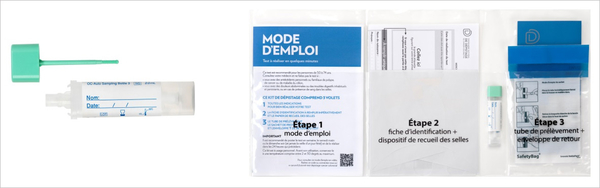
This test is easy to use. It involves a single stool sample collected using a swab, which is then placed in a sealed tube to ensure proper preservation. The test, along with the information sheet provided with the kit and to be completed by the person performing the test, should be sent via the prepaid envelope provided to the medical testing laboratory, whose contact information is listed on the envelope. Watch the video instructions for the screening test.
The test and screening kit provided by your primary care physician
The National Cancer Institute’s information campaign
To mark Colorectal Cancer Awareness Month, the National Cancer Institute, in partnership with the Ministry of Solidarity and Health, is launching a media information campaign to highlight the importance of colorectal cancer screening and encourage increased participation.

Scheduled to air on television from February 18 to March 11 and online from February 19 to March 31, this campaign highlights the paradox between the deadly nature of this cancer—18,000 deaths per year—and the existence of effective screening—the cure of 9 out of 10 cancers when detected at an early stage.
The ad’s tagline reminds viewers that screening can save lives: “Colorectal cancer: early detection can save your life.”
Through the end of March, the Institute will also be active on its social media platforms, emphasizing the need for action on this public health issue.
At the same time, an information initiative targeting general practitioners is being launched. Messages will be sent to them via the main prescription support software platforms and also via email. The involvement of healthcare professionals is essential; it is during a consultation that they ensure their patient is eligible for organized screening and, if so, provide them with the test after explaining how to use it. It is therefore important to make it a habit to discuss the importance of this screening—recommended every two years—during consultations.
Key Figures on Colorectal Cancer
Learn more:
Download the infographic on colorectal cancer screening
Visit the section dedicated to colorectal cancer screening
Watch the video instructions for the screening test and the animated films:- Colorectal cancer: Why get screened?- Colorectal cancer screening: Who? When? How?
Access the evaluation data on the national colorectal cancer screening program
Our latest news

news
Shamonda Virus: First Human Case Detected in France—What Do We Know?

news
Call for Nominations for the Renewal of the Scientific Advisory Board of the...

news












