


Be on the lookout for leptospirosis during the southern hemisphere summer, especially after Cyclone Belal has passed!
cp_lepto_reunion_20240122.pdf
Download (PDF - 313.75 KB)
Press Contacts
ARS La Réunion Communications
Department
0262 97 97 17 – 0692 57 63 38
ars-reunion-communication@ars.sante.fr
Santé publique France
presse@santepubliquefrance.fr
Stéphanie Champion: 01 41 79 67 48
Camille Le Hyaric: 01 41 79 68 64
Following the passage of Cyclone Belal and the surge in leptospirosis cases typically seen at the start of the southern hemisphere summer, the Regional Health Agency of Réunion (ARS La Réunion) and Santé publique France are advising the public to remain vigilant and take simple precautions to avoid contracting the disease.
In 2023, 171 cases of leptospirosis were reported to the ARS La Réunion. Leptospirosis is a serious disease: if not treated in time, it can lead to hospitalization or even death.
At the start of the southern hemisphere summer, an increase in cases is usually observed. The bacteria that cause leptospirosis thrive particularly during the rainy season and even more so after a cyclone.
Humans can become infected through contact with a contaminated, damp environment (mud, puddles, etc.) or directly through contact with the contaminated urine of infected animals, particularly rats. Activities such as cleaning yards and gardens without adequate protection (boots, gloves, etc.) or swimming in freshwater after heavy rains are therefore particularly risky. Extra caution is therefore recommended after a cyclone has passed.
Agricultural workers (farmers, livestock breeders) are also particularly at risk due to their occupational activities.
The ARS La Réunion and Santé Publique France recommend that the public remain vigilant during the southern hemisphere summer and protect themselves by taking simple precautions to avoid contracting leptospirosis.
Epidemiological Situation
The rainy season is the period of highest risk because it presents temperature and rainfall conditions favorable to the survival in the environment of the bacteria responsible for this disease.
Episodes of heavy rain promote soil leaching and environmental contamination and are therefore particularly high-risk periods.
In 2023, 171 cases of leptospirosis were reported to the ARS of Réunion, with more than 70% occurring between January and June 2023:
Men were affected more than women (more than 9 out of 10 cases).
Cases ranged in age from 10 to 81 years, with the 50–69 age group accounting for nearly half of all cases.
The entire island was affected, although the southern region was the hardest hit in 2023 (accounting for more than half of the reported cases).
Nearly 7 out of 10 cases required hospitalization.
What is leptospirosis and what are the symptoms?
The animal reservoir is very diverse, and in addition to rodents (mainly rats), it includes certain carnivores, certain livestock (cattle, goats, sheep, horses, pigs), and pets (dogs).
The bacteria survive quite easily in the external environment (freshwater, muddy soil). They can survive for several weeks in freshwater, soil, or a humid environment, which facilitates transmission.
In humans, direct contamination (animal contact) is rare compared to indirect contamination (contact with contaminated soil or water, mud, puddles, or stagnant water along ravines).
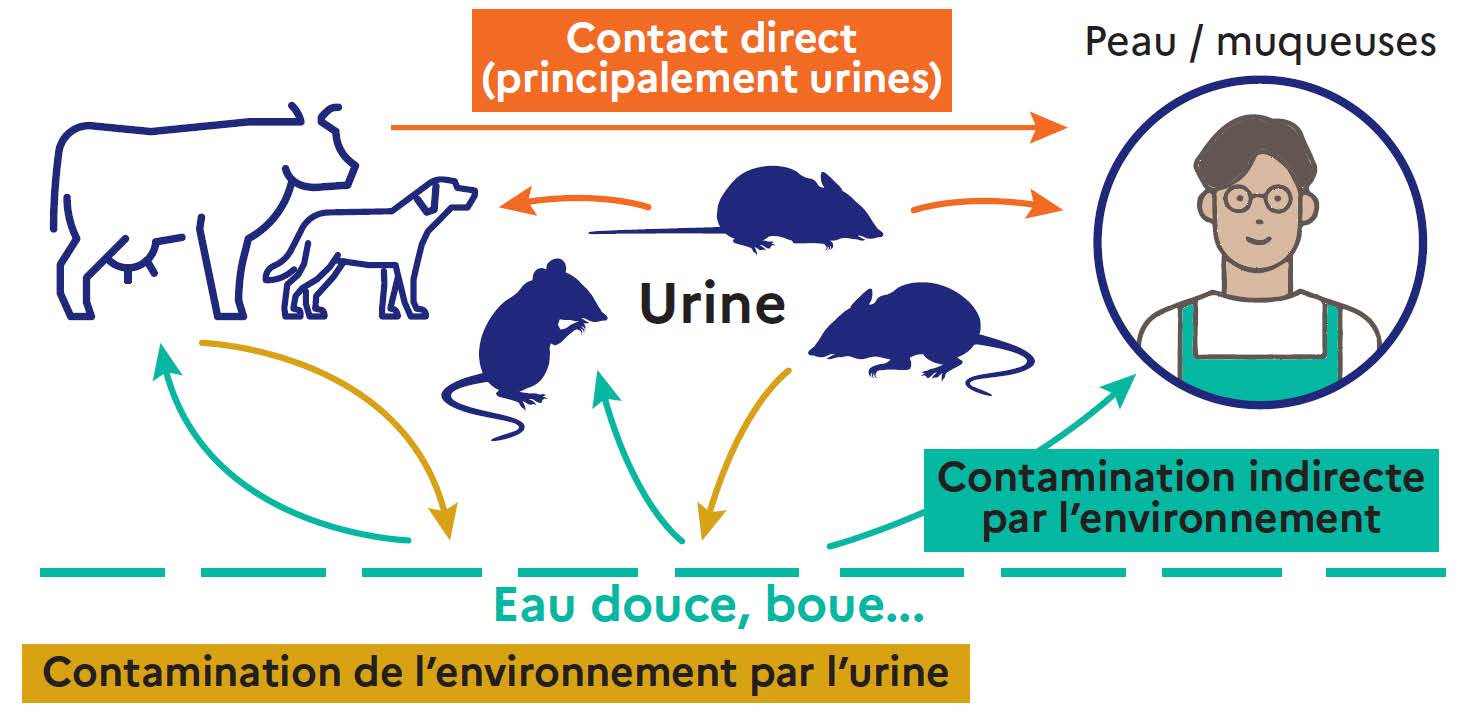
The bacteria enter the body through the skin via cuts or wounds (even small ones) or through the mucous membranes (eyes, mouth, nose). After a few days of incubation (4 to 19 days on average), leptospirosis presents with the following symptoms (which can easily be confused with other infections such as dengue, COVID-19, etc.):
sudden onset of high fever (often > 39 °C);
muscle, joint, and abdominal pain;
nausea, vomiting;
severe headaches.
The disease can worsen 4 to 5 days after the first signs appear and spread to the liver, kidneys, lungs, and meninges, and can be fatal.
When administered early, antibiotic therapy reduces the risk of complications and alleviates symptoms.
What activities carry a risk?
The vast majority of cases reported on the island are linked to:
agricultural work;
gardening and livestock farming (“la kour”);
freshwater recreation (fishing, swimming in rivers or ponds, whitewater sports).
Most people infected in 2023 had unprotected wounds or lacked adequate protective gear (boots, gloves, goggles, wetsuits, etc.).
What should you do if you experience symptoms in the days following a high-risk activity?
See your doctor promptly.
Inform them of any activities with a risk of infection undertaken within 3 weeks before the onset of symptoms.
The doctor may order a laboratory test to confirm or rule out the diagnosis.
Since August 23, 2023, leptospirosis has been a notifiable disease. Any case of leptospirosis, confirmed by laboratory tests, must be reported to the Regional Health Agency’s surveillance and alert unit using the mandatory reporting form.
The ARS then offers to conduct an environmental investigation at the patient’s home to identify potential sources of exposure and high-risk activities. Analyzing these investigations helps better characterize cases and their risk exposures, inform patients about preventive measures to implement, and prevent future exposures.
How can you protect yourself from leptospirosis?
Prevention of leptospirosis relies on individual protective measures against contamination from animal urine. Simple measures can effectively limit the risk of contamination:
Implement personal protective measures:
wear appropriate protective gear during high-risk activities (gloves, boots, coveralls, etc.);
protect wounds from contact with water (waterproof bandages), wash them with drinking water, and disinfect them after exposure;
do not walk barefoot or in flip-flops during activities in wet or muddy environments (muddy ground, puddles, standing water, ravines).
Control rats:
maintain your yard regularly (remove clutter or waste that could attract rats, etc.);
eliminate all food sources (including animal food scraps).
Protect your pets:
vaccinate dogs against leptospirosis;
do not let your pets roam freely.
Obey swimming bans in areas marked as high-risk. It is best to postpone recreational activities in freshwater if the water is murky.
These preventive measures should be followed especially after periods of heavy rain, as the risk of contact with contaminated wet environments is higher then.
Get vaccinated:
A vaccine against leptospirosis is available for people most at risk of infection. The vaccine protects only against one form of leptospirosis (Leptospira icterohaemorrhagiae). It involves three initial injections followed by a booster every two years.
The vaccine is reserved for certain high-risk occupational groups or individuals who regularly engage in high-risk recreational activities, following an individualized assessment by a doctor. Vaccination of at-risk groups in no way exempts individuals from the systematic implementation of preventive measures.
Leptospirosis
thematic dossier
Leptospirosis is a bacterial zoonosis found worldwide. In France, leptospirosis is a public health concern, particularly in the overseas territories, where the incidence is high.
Our latest news

news
Growing Up with Screens. A special report in *La Santé en action* No. 474,...

news
Seniors, pregnant women, and nursing home staff: What is the status of their...

news












