


Salmonellosis Outbreak Caused by Salmonella enterica Serotype Agona Among Infants in France – Update as of December 5, 2017
Between August and November 2017, several infants were identified by the National Reference Center for Salmonella as having salmonellosis caused by Salmonella serotype Agona. The parents of these infants reported that their children had consumed exclusively Pepti Junior brand formula from Picot, Picot SL, and Milumel Bio 1 (palm oil-free). Santé publique France has issued an update on the ongoing investigations and is reminding the public of the hygiene guidelines to follow when preparing infant formula.

Update on the Situation
In November 2017, the National Reference Center (CNR) for Salmonella (Institut Pasteur, Paris) identified an unusual number of young children with Salmonella Agona serotype salmonellosis. The identification of 8 cases in 8 days triggered an alert and led to the launch of epidemiological investigations on December 1 among the parents of the infants.
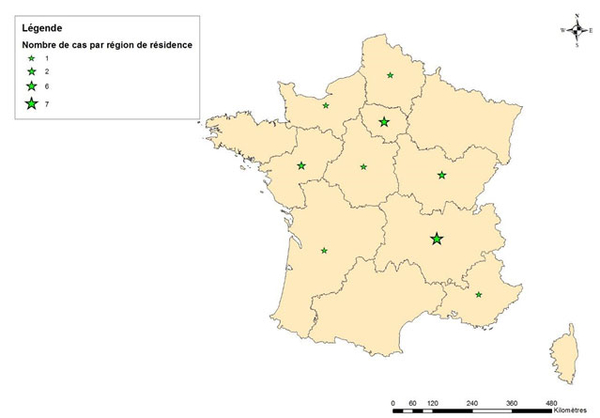
The epidemiological investigation currently being conducted by Santé publique France in collaboration with the NRC has so far identified 22 infants (9 boys and 13 girls) with Salmonella Agona serotype salmonellosis, occurring between mid-August and late November. These infants reside in 9 different regions (7 in Auvergne-Rhône-Alpes, 6 in Île-de-France, 2 in Burgundy, 2 in Pays de la Loire, 1 in Provence-Alpes-Côte d’Azur, 1 in Aquitaine, 1 in Lower Normandy, 1 in the Centre region, and 1 in Hauts-de-France). They are all under 6 months of age.
To date, the families of 18 infants have been contacted and interviewed. These 18 infants presented with diarrhea, including 8 with blood in their stools and 13 with fever; 8 (44%) were hospitalized. All have now recovered.
Of these 18 infants, 17 consumed, within the 3 days preceding the onset of their symptoms, Pepti Junior by Picot, Picot SL, or Milumel Bio 1 palm oil-free formula; these 3 formulas are manufactured at the same production site. The infants had not consumed any other food or drink in common, and the bottles were prepared with bottled water from 6 different brands.
Geographic distribution of the 22 infants with Salmonella Agona serotype salmonellosis, August–November 2017
Preliminary results of the investigation strongly suggest that Picot’s Pepti Junior, Picot SL, and Milumel Bio 1 palm oil-free formulas are the source of these Salmonella Agona infections.
On December 2, 2017, the manufacturer, in coordination with the Directorate General for Competition, Consumer Affairs, and Fraud Control and the Directorate General for Health, proceeded with the withdrawal and recall of all affected products. It has also set up a toll-free number for parents—0800 120 120 (open from 9:00 AM to 8:00 PM)—to answer their questions.
12 batches affected to date:
Picot SL Lactose-Free Milk, Stage 1, 350g:
BATCH: 17C0012344 - Best Before 02/15/2019
BATCH: 17C0012877 - Best Before 06/01/2019
BATCH: 17C0013216 - Best Before 09/18/2019
LOT: 17C0013549 - Best Before 09/29/2019
Pepti Junior Lactose-Free Infant Formula, Stage 1, 460g:
BATCH: 17C0012512 - Best Before 09/14/2018
BATCH: 17C0012856 - Best Before 12/01/2018
Batch: 17C0013179 - Best Before 02/01/2019
Milumel Organic Infant Formula, Stage 1, 900g, palm oil-free:
LOT 17C0012592 – Best Before Date: 04/03/2018
LOT 17C0012845 – Best Before Date: 05/22/2018
BATCH 17C0012848 – Best Before Date: 08/26/2018
LOT 17C0012960 – Best Before Date: 09/12/2018
LOT 17C0013084 – Best Before Date: 10/13/2018
Parents who still have cans from these lots should not use them, whether they are unopened or already opened. They should contact their pediatrician or doctor to receive specific advice on a replacement formula, particularly for babies allergic to milk proteins. In the meantime, they can visit a pharmacy where a substitute formula will be offered to them. The French Society of Pediatrics has issued recommendations to this effect (see the appendix to the press release for a list of possible replacement milks).
Hygiene measures to follow
Santé publique France reminds the public of the hygiene principles to follow when preparing bottles:
Hands must be washed thoroughly with soap and water before handling the bottle;
bottles should not be prepared in advance;
bottles must be cleaned immediately after use.
Reminders about the disease
Salmonella infections occur within 3 days of ingestion and cause symptoms of gastroenteritis, including vomiting, diarrhea (which may be bloody), and fever in most cases. If these symptoms appear in an infant, families should consult a doctor.
Salmonella Agona is one of approximately 2,000 Salmonella serotypes that are pathogenic to humans. From 2012 to 2016, the CNR for Salmonella identified approximately 65 strains of Salmonella Agona per year. Like most other Salmonella serotypes, Salmonella Agona is found in France in various animal reservoirs, including poultry, cattle, pigs, and animal feed.
Several outbreaks of Salmonella Agona-associated salmonellosis have been reported in the past, notably an outbreak attributed to the consumption of powdered milk by infants in France in 2005, an outbreak among infants in Germany attributed to the consumption of fennel and anise herbal teas², and outbreaks attributed to the consumption of peanut snacks³ or oat-based cereals⁴.
References1Brouard C, Espie E, Weill FX, Brisabois A, Kerouanton A, Michard J, Hulaud D, Forgues AM, Vaillant V, de Valk H. Outbreak of Salmonella enterica serotype Agona salmonellosis linked to the consumption of infant formula, France, January–May 2005. Bull Epidemiol Hebd 2006;(33):248-50. 2Koch J, Schrauder A, Werber D, Alpers K, Rabsch W, Prager R, Broll S, Frank C, Roggentin P, Tschäpe H, Ammon A, and Stark K. A nationwide outbreak of Salmonella Agona in infants due to aniseed in herbal tea, Germany, October 2002–July 2003. 5th World Congress, Foodborne Infections and Intoxications, June 7–11, 2004, Berlin, Germany.3Killalea D, Ward LR, Roberts D, et al. International epidemiological and microbiological study of an outbreak of Salmonella Agona infection from a ready-to-eat savory snack—I: England and Wales and the United States. BMJ 1996;311-13.4From the Centers for Disease Control and Prevention. Multistate outbreak of Salmonella serotype Agona infections linked to toasted oats cereal—United States, April–May, 1998. JAMA. 1998 Aug 5;280(5):411












