


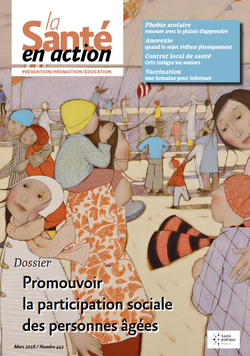
Promoting Social Participation Among Older Adults: A Feature Article in *La Santé en action* No. 443, March 2018
In the April 2018 issue of its quarterly journal *La Santé en action*, Santé publique France publishes a special feature on the topic of "social participation among older adults," which provides an overview of trends in public policies on healthy aging and discusses the unique challenges associated with advanced age and caring for a loved one.
It is a well-known fact, backed by scientific studies: older adults who are socially active enjoy better physical and mental health than those who remain inactive. So how can we create an environment that fosters the inclusion of older adults in society? The special report in *La Santé en action* No. 443, to which twenty experts contributed, addresses the issue of older adults’ social participation.
Promoting older adults’ participation in society: the key to aging well
France has 13 million people aged 65 and older, representing 19.6% of its total population. Isolation and loneliness affect about one-quarter of those aged 75 and older. With a focus on prevention and health promotion, and a comprehensive and positive approach to aging, public authorities developed a national “Aging Well” plan (2007–2009) and enacted a law in 2016 on “adapting society to aging.” The goal is to prevent chronic diseases, maintain cognitive and physical functioning, and encourage older adults’ engagement in social life: a means of enhancing individuals’ ability to adapt to aging, but also a factor in combating isolation and recognizing the value of older adults in civic and political life.
Older adults, aging, social participation: what are we talking about?
The heterogeneity of the older population stems from age (the pre-World War II generation, the baby boomer generation, etc.) but also from life course, occupation, gender, social and economic environment, place of residence, culture, and so on. These factors influence the experiences of aging, and geriatricians thus distinguish between robust older adults (70%), frail older adults (20%), and dependent older adults (10%). This heterogeneity means there is no universally accepted standard age to define the onset of old age.
Healthy aging can be defined as the "process of optimizing opportunities for good health, participation, and security to enhance quality of life during old age" so that "older adults remain a resource for their families, communities, and the economy."
The social participation of older adults (who are independent and living at home) is understood to mean “remaining an active member of one’s community,” “being active and participating in civic activities, as well as in leisure and recreational activities,” not to mention interpersonal relationships, particularly those across generations. Here, this social life is distinguished by the fact that it can no longer rely on the world of work and must take different forms: volunteer work, responsibilities in decision-making bodies of cities and local communities, etc.
Promoting this participation therefore requires creating supportive socio-economic environments and systems; removing barriers; and compensating for the loss of abilities or autonomy.
Learn more:
Promoting the social participation of older adults. La Santé en action No. 443 – March 2018. 52 p.
La Santé en action is the quarterly journal of Santé publique France dedicated to prevention, education, and health promotion. It is fully accessible in digital format. The print version is reserved for professionals working in public settings (schools, hospitals, etc.).












