
infographics
The Story of a Food Recall
How does a food safety alert work in France? What is the organizational structure? Santé publique France outlines the process—from patient consultation to the issuance of an alert—in an infographic.




Santé publique France has released its annual surveillance data on hemolytic-uremic syndrome in children under 15 in France, which is also available as open data on Géodes. In 2021, a slight decrease in the number of cases was observed.

thematic dossier
Hemolytic uremic syndrome is a primarily renal complication of infections caused by Shiga toxin-producing Escherichia coli. Although rare, it is a serious condition that primarily affects young...
Hemolytic uremic syndrome (HUS) is a primarily renal complication of infections caused by Shiga toxin-producing Escherichia coli (STEC), which can be transmitted through food, a contaminated environment, or person-to-person contact. Although rare, it is a serious condition that primarily affects young children. Before progressing to HUS, these infections cause abdominal pain accompanied by bloody, mucus-containing diarrhea or, more rarely, simple diarrhea. Each year, between 100 and 160 cases of pediatric HUS are reported to Santé publique France. The Agency has coordinated the surveillance of pediatric hemolytic uremic syndrome in France since 1996 in collaboration with the National Reference Center for E. coli, Shigella, and Salmonella (Institut Pasteur, Paris) and its associated National Reference Center (AP-HP, Robert Debré University Hospital, Microbiology Department, Paris).
128 reported cases of pediatric HUS
The incidence observed in 2021 is the lowest since 2017: 1.12 cases per 100,000 children under 15
Higher incidence among children under 3 years of age (4.30 cases per 100,000 children)
Highest incidence rates observed in Bourgogne-Franche-Comté and Auvergne-Rhône-Alpes
Serogroup 026 remains the most common in France, accounting for 35.1% of confirmed cases.
Outbreak of a foodborne illness (FBI) in a school setting caused by STEC O157 and linked to the consumption of raw cucumbers in a salad. In total, 35 cases of infection, including eight confirmed cases of STEC O157 (two HUS), were linked to this foodborne illness outbreak. This is the first outbreak in France linked to the consumption of vegetables where contamination in the suspected food item has been documented.
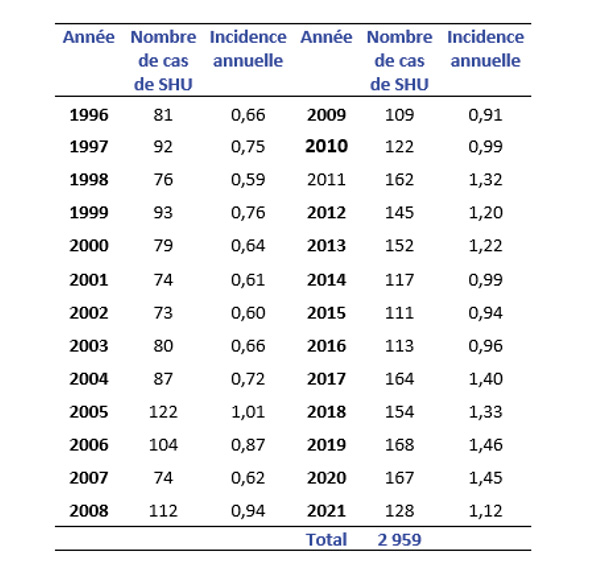
As in previous years, there is geographic variation in the incidence of pediatric HUS, with a summer peak in reported cases. The usual seasonal peak was observed in 2021, particularly in August. Aside from this August peak, the number of reported cases remained relatively low during the summer of 2021 compared to previous years. For the first time in four years, there has been a decline in annual incidence, though it remains high among children under 3 years of age.
In addition, 11 epidemiological investigations were initiated in 2021 regarding clusters of pediatric HUS or STEC infections, compared to 17 in 2020. Three of these investigations identified a source of contamination: two clusters in childcare settings and a foodborne illness outbreak linked to the consumption of raw cucumbers.
Download

bulletin national
21 October 2022
The E. coli bacteria responsible for HUS are present in the intestines of many ruminant animals (cows, calves, goats, sheep, etc.) and are excreted in their feces, which can then contaminate the environment (water, manure, soil) and food. These bacteria tolerate cold temperatures well (they survive in a refrigerator or freezer) but are destroyed when cooked thoroughly.
A few simple tips to reduce the risk of transmission:
In the kitchen
Always wash your hands before preparing meals;
Meat, especially ground beef, as well as ground meat products, must be thoroughly cooked to an internal temperature of 70°C (not pink or rare);
Raw milk, cheeses made from raw milk, and dairy products made from raw milk should not be consumed by children under 5 years of age (opt for hard-pressed cheeses [such as Emmental, Comté, Gruyère, Beaufort], spreadable processed cheeses, and cheeses made from pasteurized milk);
Flour-based preparations (pizza, cookie dough, cake, pie, crepes, etc.) should not be eaten raw or undercooked;
Vegetables, lettuce, fruits, and herbs, especially those to be eaten raw, must be thoroughly washed before consumption, after peeling if necessary;
Raw foods must be stored separately from cooked or ready-to-eat foods;
Prepared meals and leftovers must be refrigerated promptly and reheated thoroughly before consumption;
Kitchen utensils (especially if they have previously come into contact with raw foods such as meat or cheese), as well as countertops, must be thoroughly washed to prevent cross-contamination.
During Activities and Leisure
Children should not drink untreated water (from wells, rivers, streams, etc.) and should avoid swallowing it while swimming (in lakes, rivers, ponds, etc.);
Very young children (under 5 years old) should avoid contact with cows, calves, sheep, goats, etc., and their environments; if contact with these animals occurs, handwashing (with soap and water) must be done systematically before the child puts their fingers in their mouth.
Ensuring epidemiological surveillance of pediatric hemolytic uremic syndrome
Detecting outbreaks and guiding control measures
Informing the general public about prevention measures
infographics
How does a food safety alert work in France? What is the organizational structure? Santé publique France outlines the process—from patient consultation to the issuance of an alert—in an infographic.












