


Monkeypox (mpox): Update on the Situation in France as of April 27, 2023
Santé publique France has released an update as of April 27, 2023, on cases of mpox (formerly known as monkeypox) since the start of the global outbreak.
New developments since the last update
Two new cases have been reported, in addition to the 17 cluster cases of mpox in the Centre-Val de Loire region.
The most recent case was reported during the first week of April.
Revised definitions of cases, high-risk contacts, and recommended actions.
Situation Update in France
This update includes cases confirmed by PCR testing as well as those not confirmed by PCR. The latter include probable cases (suggestive clinical signs + high-risk contact with a confirmed case) and possible cases (suggestive clinical signs + exposure to a potential source of infection), which have been removed from the new case definitions and guidelines. Indeed, due to the low number of new cases, the predictive value of clinical diagnosis decreases, and these possible cases must be retested.
At the international level, and due to differences in surveillance protocols across countries, biologically confirmed cases remain the benchmark for comparing epidemiological situations between countries.
In early May 2022, cases of monkeypox (mpox) with no direct link to travel in Central or West Africa—where the virus is present—or to travelers returning from those regions, were reported in Europe and around the world. Since then, the disease has been subject to enhanced surveillance in France and across Europe, based on mandatory reporting, for which the form has been specifically updated.
As of April 27, 2023, at 12:00 p.m., 5,002 cases of mpox virus infection had been recorded in France, representing 2 additional cases since the March 23 report. Of these 5,002 cases, 4,146 (83%) have been biologically confirmed.
The distribution of cases by region of residence (or by region of reporting when the region of residence is unknown) is shown in Figures 1 and 2. The Île-de-France region has the highest number of cases (3,120, or 63%), followed by Auvergne-Rhône-Alpes (356 cases), Provence-Alpes-Côte d’Azur (334 cases), and Occitanie (330 cases); 27 cases reside abroad. The 22 cases that have occurred since the beginning of 2023 are all men, and among them, 19 were diagnosed in the Centre-Val de Loire region (see below).
The vast majority of adult cases (aged 15 and older) reported to date are male. Only 2.9% of them are female (143 cases, including 112 biologically confirmed cases). No female cases have been diagnosed since the beginning of 2023.
The median age of adult cases is 36 years; 25% of cases are under 29 years old, and 25% are between 43 and 81 years old.
Twenty-four children under the age of 15 (0.5% of total cases) have been reported since May 2022 (including 12 biologically confirmed cases). No pediatric cases have been diagnosed since the beginning of 2023.
Biologically
unconfirmed cases have a profile comparable to confirmed cases: 3.7% of adults are female (vs. 2.7% of confirmed adult cases), the median age of adults is 36 years, as in confirmed cases, and the majority reside in the Île-de-France region (72% vs. 61% of confirmed cases).
Among all cases for which information is available, 101 (3.2%) were hospitalized for treatment of their mpox virus infection; this proportion has remained stable over time.
No deaths have been reported to date.
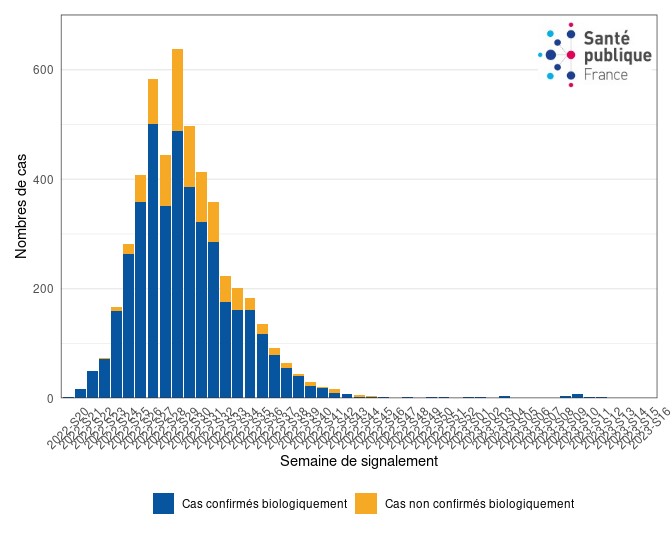
The distribution of cases by date of symptom onset (when known) and case type (biologically confirmed or not) is shown in Figure 3. The date of symptom onset for these cases ranges from May 7, 2022, to March 24, 2023. Due to reporting delays, data from the most recent weeks have not been consolidated. The reports received do not always mention the date of symptom onset. As an alternative to this information, the distribution of cases by date of reporting is presented in Figure 4.
Figure 1. Total monkeypox cases (n = 4,975) by region of residence (or by region of reporting when the region of residence is unknown), France, May 2022–April 2023 (data as of April 27, 2023 – 12:00 p.m.)
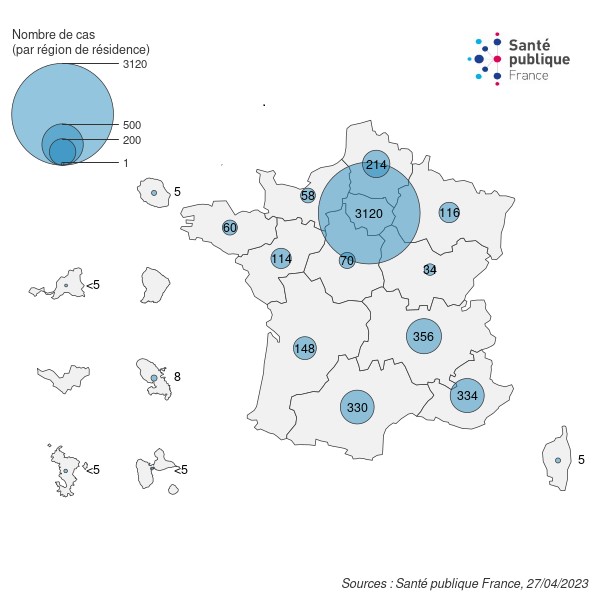
Figure 2. Biologically confirmed cases (n = 4,124) by region of residence (or by region of reporting when the region of residence is unknown), France, May 2022–April 2023 (data as of April 27, 2023 – 12:00 p.m.)
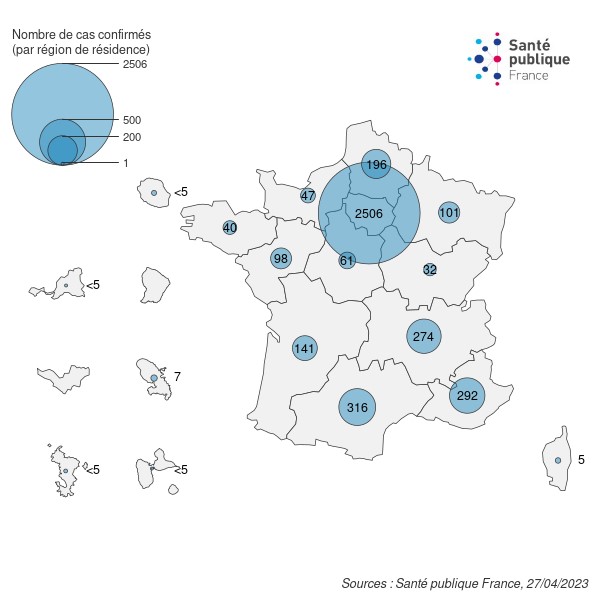
Figure 3. Monkeypox cases (n = 3,781 cases, number of missing data points = 1,221) by week of symptom onset and by case type (biologically confirmed or not), France, May 2022–April 2023 (data as of April 27, 2023 – 12:00 p.m.).
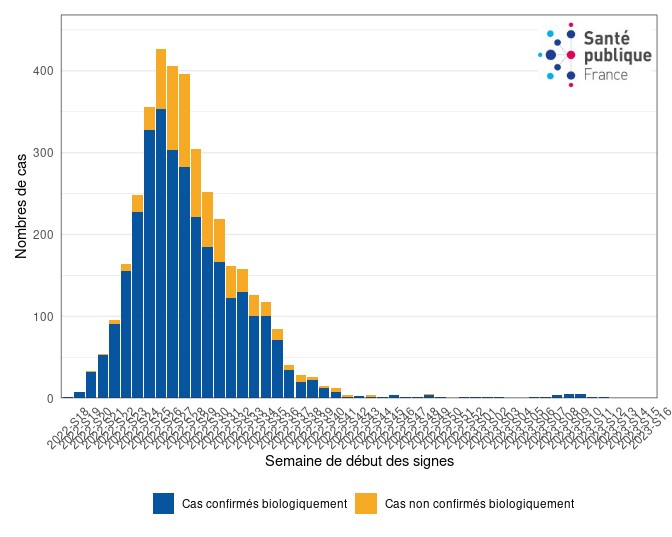
Figure 3. Monkeypox cases (n = 5,000 cases, number of missing data points = 2) by week of reporting and by case type (biologically confirmed or unconfirmed), France, May 2022–April 2023 (data as of April 27, 2023 – 12:00 p.m.).
Clustered cases in the Centre-Val de Loire region, January–April 2023
Between January 1, 2023, and April 3, 2023, 19 confirmed cases in males were reported in the Centre-Val de Loire region, including 16 since March 1.
The investigation revealed that all but one of these cases involved men who have sex with men (MSM), several of whom reported having had multiple partners but were not always able to identify them. No party or event common to a majority of the cases was identified.
The cases range in age from 24 to 56 years (median age 40). The clinical characteristics of these cases remain similar to those previously observed; no cases required hospitalization.
Among the 19 cases, 7 had not received any smallpox vaccination, 2 reported an incomplete vaccination history (childhood vaccination with a first-generation smallpox vaccine for one, and one dose of a third-generation vaccine in 2022 for the other), and 10 reported a complete vaccination history: 4 with a first-generation smallpox vaccine in childhood + 1 dose of a third-generation vaccine in 2022, and 6 with 2 doses of a third-generation vaccine in 2022.
Given the high proportion (53%) of vaccinated individuals in this cluster, investigations were conducted by Santé publique France and the Regional Pharmacovigilance Center in Tours. The proportion of vaccinated cases is higher than what is observed at the national level (25% of male mpox cases reported between October and February 2023 in France involved vaccinated men). We should await the results of real-world efficacy studies, which will allow for a better interpretation of these data. To date, there is little long-term data on the efficacy of third-generation vaccines against mpox infection. There are no data on long-term protection following a full vaccination series, nor in specific population subgroups. These vaccines are subject to pharmacovigilance monitoring coordinated by the ANSM. To date, no safety concerns have been raised regarding the quality or safety of these vaccines.
The mpox virus DNA from the 19 cases (swabs collected between January 23 and March 21) was sequenced by the national reference laboratory (IRBA). Preliminary results have linked the sequences from 11 cases to lineage B1 of clade IIb (the clade responsible for this global outbreak). Further analyses are still underway for the remaining cases.
To date, this outbreak indicates localized transmission in the Touraine region, with virtually no reported cases in the rest of the country. Among the reported cases, some have indicated high-risk contacts and exposures in other regions, particularly in the Île-de-France region.
No new cases have been reported since April 3.
Pending robust data on the real-world efficacy of mpox vaccines, this cluster calls for vigilance. Mpox infections can occur in individuals who have received a full course of vaccination, and it is important to consider this diagnosis in cases of skin or mucosal rashes, including in properly vaccinated individuals. Mpox surveillance requires that vaccination status be collected for all notifiable mpox cases.
To date, this outbreak indicates localized transmission in the Touraine region, with virtually no reported cases in the rest of the country. Prevention recommendations remain in effect, particularly avoiding sexual contact if lesions suggestive of mpox are present and using condoms for 2 months after recovery. Vaccination remains recommended and remains effective in the majority of people who have received a full vaccination series to prevent the risk of infection. It is important to ensure that eligible individuals*, including MSM with multiple partners, are up to date on their mpox vaccination. For individuals born before 1979, in the absence of proof of smallpox vaccination in their immunization record or a characteristic scar, it is recommended that they receive a second dose of the third-generation vaccine.
After the peak in infections reached in late June/early July 2022, the number of cases dropped sharply—whether biologically confirmed or unconfirmed—and very few cases were reported between November 2022 and April 2023. However, some cases may not have sought medical care and may therefore not have been diagnosed or reported.
This apparent low incidence rate is also observed globally, with 247 cases reported over the past three weeks, the majority of which were reported in the Americas (63%) and the Western Pacific (25%). In Europe, 27 cases were reported over the past three weeks, compared to 6 cases over the previous three weeks (WHO).
Pending robust data on the real-world effectiveness of mpox vaccines, the cluster observed in the Centre-Val de Loire region calls for vigilance as the season of international MSM festivals and Pride parades approaches. Prevention recommendations remain in effect, particularly avoiding sexual contact if lesions suggestive of mpox are present, and using condoms.
Mpox infections can occur in people who have received a full course of vaccination, and it is important to consider this diagnosis in cases of lesions typical of mpox, including in properly vaccinated individuals. Mpox surveillance requires that vaccination status be collected for all mpox cases subject to mandatory reporting.
Information and Prevention Initiatives
Sexosafe (sexosafe.fr) continues to address mpox infection on its social media accounts to keep the topic relevant to the relevant audiences.
Additionally, posters and flyers encouraging self-monitoring of symptoms and vaccination are still available.
To order them:
Log in to your account or create one
Enter the following campaign code: MPOX2023
Select the desired documents and confirm your order
Only one order per person. Campaign valid through 12/29/2023. While supplies last.
* Opinion of July 7, 2022, from the Board of the French National Authority for Health regarding pre-exposure vaccination against monkeypox for individuals at high risk of exposure
https://has-sante.fr/jcms/p_3351308/fr/avis-n2022-0039/ac/sespev-of-July-7-2022-from-the-College-of-the-Haute-Autorité-de-Santé-regarding-pre-exposure-vaccination-against-the-monkeypox-virus-for-individuals-at-high-risk-of-exposure
In the region

Smallpox B (Mpox)
thematic dossier
Smallpox B (Mpox), formerly known as monkeypox, is a rare viral infectious disease caused by the monkeypox virus and transmitted primarily from rodents to humans, and then from person to person,...












