



How do the French perceive the environmental risks to their health?
Santé publique France has released the second part of the results of a study on the French population’s level of awareness and perception of environmental health risks, based on data from the 2021 Santé publique France Health Barometer.
surveys/studies
More information on health surveys
The Santé publique France Health Barometer: a survey of health-related behaviors, opinions, and knowledge designed to guide public health prevention and education policies.
Through repeated surveys of the general population over time, Santé publique France studies and monitors key health behaviors, attitudes, and perceptions related to risk-taking among the French population. It is within this framework that questions regarding the perception of information and environmental health risks were included in the 2019, 2021, and 2023 editions of the Santé publique France barometers.
The results of the second part of the study published today concern: pesticides, outdoor air pollution, noise, extreme weather events, heavy metals, contaminated soil, radon, invasive plants, and sun exposure. In addition to the fact that these environments characterize collective exposures to chemical, biological, or physical risks, these topics all share the common feature of presenting local characteristics or specificities.
These findings aim to identify environments where there is a need for public information and to help guide prevention and promotion strategies in the field of environmental health.
Perceptions of knowledge vary depending on the environmental topic surveyed
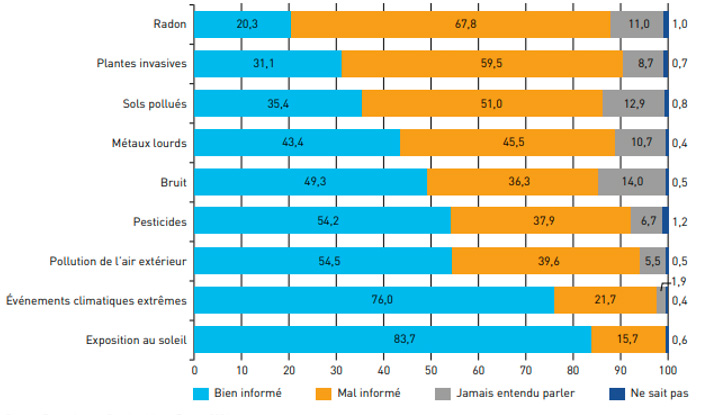
Of the nine topics covered, the proportion of people who say they are well-informed about the health effects is lowest for radon (20%) and invasive plants (31%). Conversely, it is highest for sun exposure (84%) and extreme weather events (76%).
Among those who reported having already heard about the health effects of the environmental topic in question, 9 out of 10 people identify outdoor air pollution (92%), heavy metals (90%), contaminated soil (89%), pesticides (89%), and extreme weather events (82%) as posing a “high” to “moderately high” risk. Fewer people identify a “high” to “moderately high” risk for noise (71%), invasive plants (66%), and radon (59%).
Older individuals and those who feel most financially secure are more likely to report being well-informed about health risks.
Regarding occupation and social class, farmers are more likely to report being well-informed about the health effects of pesticides, and manual laborers are more likely to report being well-informed about the health effects of noise. This may be explained by the relevance of these topics in their professional environments. It is worth noting that, paradoxically, farmers are less likely to perceive a high risk from pesticides.
Perceptions of health effects associated with environmental issues
Go beyond simply providing information on risks and enhance public awareness through the workplace or appropriate regulatory tools
Beyond simply providing information on the health risks associated with environmental exposure, it appears necessary to encourage the public to take ownership of these health risks and adopt best practices to protect themselves. Complementary awareness-raising and educational efforts by various stakeholders, particularly prevention organizations, would enable the public to identify public health issues linked to environmental exposures and help them adapt to potential risks.
Furthermore, the workplace appears to be an effective venue for information and prevention regarding various environmental issues. The dissemination of information regarding the health risks of various environmental exposures at work could therefore be encouraged, in addition to other existing measures.
Finally, the development of regulatory tools, such as those proposed under the Law on Access to Housing and Urban Renewal (ALUR), is an example of awareness-raising efforts that should be optimized to enable everyone to identify public health issues related to environmental exposures and thus facilitate their adaptation.
Download

enquêtes/études
1 February 2024
Perceptions of Information and Environmental Risks – Part Two. Results of the 2021 Santé publique France Barometer
The three phases of the study
Part 1, conducted in 2019 and published in 2021, focused on individual exposures to chemical or physical risks, such as the use of cell phones, cosmetics, or artificial ultraviolet radiation.
Part 2, conducted in 2021 and whose results are being published today, examined collective exposures to chemical, biological, or physical risks with local characteristics or specificities, such as exposure to radon, outdoor air pollution, invasive plants, or contaminated soil.
Phase 3, scheduled for 2023, will focus on collective exposure to chemical, biological, or physical risks that have few or no local characteristics, such as exposure to electromagnetic waves, pollen, or pollutants in tap water.
What is the purpose of the health-environment questions in the Health Barometers, and what do these results contribute?
The 2021 Santé publique France Health Barometer surveyed the population on nine environmental topics that may have regional characteristics or specificities for which local or national authorities have developed strategies to raise awareness, communicate, or even mitigate public exposure.
The purpose of these questions is to identify:
the environmental issues perceived as insufficiently understood by the public, particularly regarding the perceived health effects of these issues;
the perceived risk of each environmental issue on public health; and to examine the characteristics associated with the sense of being informed and the perception of risk, both in terms of sociodemographic factors and in relation to pro-environmental behaviors.
The knowledge gained aims to promote the development of awareness campaigns targeting the public and prevention professionals on environmental topics about which the public appears to be least informed.












