


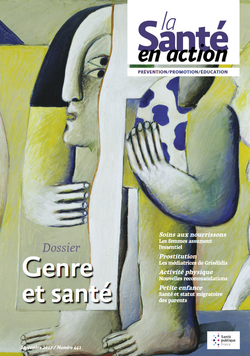
Gender and Health: The Special Issue of *La Santé en action* No. 441, September 2017
In the September 2017 issue of its quarterly journal, *La Santé en action*, Santé publique France publishes a special feature on the topic of "gender and health," which provides an overview of current research and practices in this field.
Gender: What Are We Talking About?
Sex, male or female, is an assignment at birth based on visible organs (anatomy). Gender refers to the non-biological differences between men and women. These differences relate to patterns of socialization; to the division of domestic labor or parenting roles in society; to different ways of caring for one’s body and health, etc.
Health inequalities between men and women are well known but have yet to be thoroughly studied from a gender perspective. Traditionally, research has separated studies on socioeconomic health inequalities from those on sex-based health inequalities, but it rarely takes gender into account in professional practices or in the practices of service users.
Gender: A Major Social Determinant of Health
The issue of gender has evolved over the past few decades, to the point where it is now taught in the training of health professionals and has entered the public sphere. Gender proves to be a determining factor in individuals’ relationship to health, intersecting with the challenges of health promotion.
The “Gender and Health” feature in issue 441 of La Santé en action aims to make accessible a topic often covered in specialized journals so that all professionals in education, health, and social services can engage with it. Through analyses and testimonials from some thirty experts and practitioners, this special section explores situations involving sex and gender relations in the world of healthcare and health promotion. It focuses on studies that apply a comparative approach to the practices of men and women regarding the consumption or production of health goods and services. It presents recent sociological research and highlights health promotion practices and field experiences that take gender into account.
The issue addresses the following questions in particular:
How have women’s movements challenged medical knowledge and public health policies?
How does gender shape practices such as alcohol and tobacco use, child care, or the decision to forgo care?
What do highly gendered professions, such as midwifery, teach us about the effects of gender?
How can we work with young people, men, women, lesbian, gay, bisexual, and transgender individuals, migrants, and people living in socially precarious situations while taking into account the effects of gender on health?
Learn more:
Gender and Health. La Santé en action No. 441 - September 2017. 52 p.
La Santé en action is the quarterly journal of Santé publique France dedicated to prevention, education, and health promotion. It is fully accessible in digital format. The print version is reserved for professionals working in public settings (schools, hospitals, etc.).












