



Fewer than half of all women underwent a screening mammogram for breast cancer in 2021–2022
Santé publique France has released new data on women’s participation in the organized breast cancer screening program for the 2021–2022 period. Every two years, this program invites women aged 50 to 74 to undergo a screening mammogram, supplemented by a clinical breast exam.

Breast cancer
thematic dossier
Breast cancer is the most common form of cancer in France and is the leading cause of cancer-related deaths among women. It is covered by a national screening program designed to detect the...
With nearly 60,000 new cases and 12,000 deaths each year, breast cancer is the most common cancer among women in France and the leading cause of cancer-related deaths. The national organized breast cancer screening program invites women aged 50 to 74 to undergo a screening mammogram every two years, supplemented by a clinical breast exam (visual inspection and palpation). The latest figures published today by Santé publique France show a participation rate of only 47.7% for the 2021–2022 period. Additionally, 11% undergo a mammogram outside the program. However, participating in organized screening allows for the early detection of potential abnormalities or cancer at an early stage, thereby increasing the chances of recovery.
Participation in the organized breast cancer screening program still marked by the consequences of the COVID-19 pandemic
2,424,599 women underwent an organized screening mammogram in 2022, corresponding to a national participation rate of 44.9% (versus 50.6% in 2021).
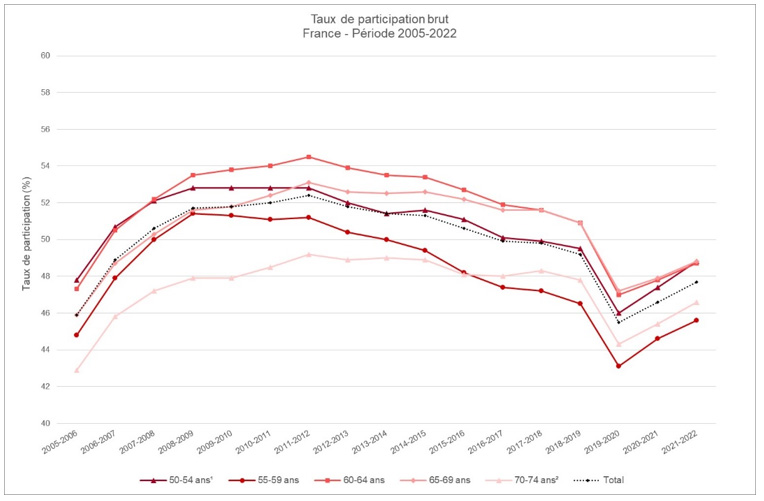
The lower participation rate observed in 2022 is partly explained by a catch-up year in 2021 linked to the shortfall observed the previous year due to the COVID-19 pandemic and lockdowns. Since women are invited every two years to undergo mammography screening, it is important to examine the data over rolling two-year periods. Thus, it appears that participation in 2021–2022 is beginning a slight upturn, with a rate of 47.7% versus 46.6% over the 2020–2021 period across all age groups, all metropolitan regions, and nearly all departments.
It will likely take a few years for the effects of the disruptions caused by COVID-19 to subside, while the gradual decline in breast cancer screening services was already leading to longer intervals between screenings.
Trends in Participation Rates in Organized Breast Cancer Screening, by Age - 2005–2022
Learn more

données
Participation rates in the organized breast cancer screening program for 2021–2022 and trends since 2005
Lower voter turnout in the Île-de-France region and the Southeast
Over the 2021–2022 period, participation at the regional level ranged from 21.2% in French Guiana to 55.3% in the Pays de la Loire, the region with the highest rate. Very low participation was observed in the Île-de-France region, the Southeast, and Corsica.
What does the organized breast cancer screening program entail?
Women aged 50 to 74 are invited to undergo a free screening mammogram every two years to detect any abnormalities or cancer as early as possible, before symptoms appear. This includes a clinical examination performed by a radiologist and two images per breast (frontal and external oblique), plus an additional image if necessary, as well as a routine second reading in the event of a normal result. The exam is covered under the third-party payment system (no upfront costs).
Mammograms are performed in both public and private radiology practices. The patient chooses their radiologist from the list of radiologists participating in the program. If the exam reveals no abnormalities in the first or second reading, a repeat exam will be recommended within two years. If an abnormality is detected, it is not necessarily cancer, and in such cases, appropriate monitoring will be recommended.
Regular screening through this program for all eligible women would significantly reduce the number of breast cancer cases.
Learn more about the screening process
Reducing the risk factors for developing breast cancer by making changes to daily habits
Among the known risk factors for breast cancer, lifestyle-related factors have been identified, including alcohol consumption, smoking, being overweight or obese, and lack of physical activity.
Santé publique France has developed information and support resources accessible to everyone to help understand health issues, reduce risks, and adopt behaviors that promote good health.
Learn more:
on tobacco:
tabac-info-service.fr website
Everything you need to know about tobacco (report)
on alcohol consumption:
the alcohol-info-service.fr website
Everything you need to know about alcohol (report)
on sedentary lifestyles and obesity:
Everything you need to know about diet and physical activity (report)












