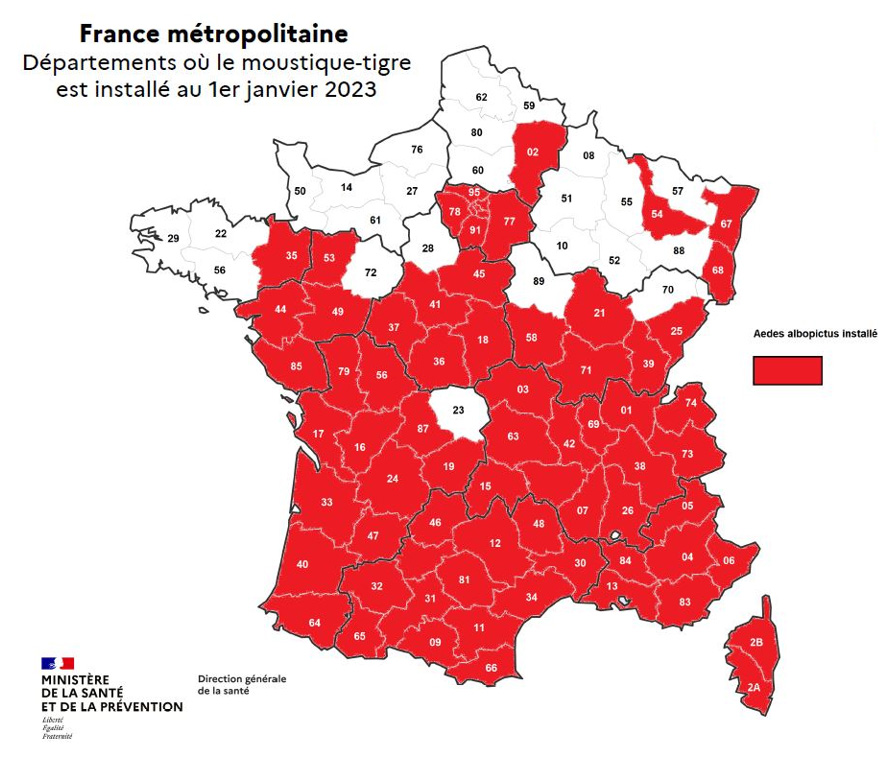
Each year, enhanced seasonal surveillance for cases of chikungunya, dengue, and Zika—coordinated by Santé publique France—is activated from May 1 to November 30, in addition to the annual surveillance based on mandatory reporting. These viral diseases, transmitted by mosquitoes of the genus Aedes, are primarily tropical but can be transmitted in Europe and mainland France by the Aedes albopictus mosquito (also known as the tiger mosquito), which is established in most departments and continues to spread across mainland France. The first locally transmitted cases of dengue and chikungunya in mainland France were observed in 2010. Since then, these outbreaks have recurred and have become a regular occurrence each year.
The year 2022 was marked by an increase in locally transmitted dengue cases, with 9 outbreaks identified totaling 65 cases. These cases were distributed across Occitanie, Provence-Alpes-Côte d’Azur, and Corsica, and outbreaks occurred in departments previously unaffected, such as Corsica, Pyrénées-Orientales, Hautes-Pyrénées, and Haute-Garonne. These outbreaks are likely to recur, increase in scale, and affect new departments. Climatic conditions favorable to mosquito proliferation—including extreme heat, heavy rainfall, flooding, drought, and global warming—as well as urbanization, increased travel, and globalization are among the factors contributing significantly to this trend.