


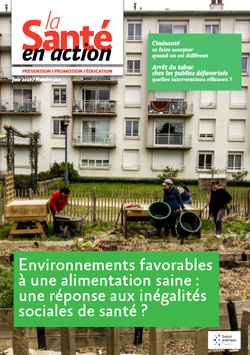
Can social health inequalities be reduced by creating environments that promote healthy eating? The “Health in Action” report, No. 444, June 2018
How can we create environments that promote healthy eating? What kinds of environments are conducive to healthy eating? And how can this help reduce social inequalities in health? In the June issue of its quarterly journal *La Santé en action*, Santé publique France publishes a special feature on this topic, highlighting strategies aimed at influencing the environment and examples of local initiatives.
The role played by poor diet and insufficient physical activity as risk factors for the most common diseases in France is increasingly well understood, whether it be cancer, cardiovascular disease, obesity, or diabetes. This is why nutrition has been placed at the heart of public health policies since 2001 with the creation of the first National Nutrition and Health Program (PNNS). In 2010, the PNNS was incorporated into the Public Health Code, demonstrating a commitment to implementing an effective and sustainable nutrition policy.
Social inequalities persist: more overweight French people among those with lower levels of education
The initial results of the Health Study on the Environment, Biomonitoring, Physical Activity, and Nutrition, published in 2017, show a stabilization in overweight and obesity rates among adults and children: 49% of French adults are overweight (including 17% who are obese); among children, this figure rises to 17% (4% of whom are obese).
However, more than 15 years after the implementation of the PNNS, we observe a widening of inequalities between social groups in terms of diet and health status: the lower the educational level, the higher the prevalence of overweight/obesity. Recent epidemiological data show that people with higher levels of education or in higher occupational and socio-professional categories (PCS) consume more fruit and fewer sugary drinks than those with lower levels of education. The same is true for children: those with parents in higher PCS consume more fruit and fewer sugary drinks than others.
Changing environments to change behaviors
Nutrition information and education campaigns conducted in isolation and focused on individual responsibility have shown their limitations. The current approach is to strengthen interventions targeting the environment (physical, regulatory, sociocultural, political, and economic) to facilitate the public’s choices of health-promoting foods. These interventions, centered on “passive” prevention, rely more on collective responsibility. Regulatory measures are part of this type of action, which may involve, for example, regulating advertising (food marketing and neuromarketing targeting children), imposing taxes on the least healthy foods and on sugary beverages such as sodas, and implementing nutritional labeling on food packaging (the Nutri-Score system, recommended by public authorities). While these measures are difficult to implement due to significant economic stakes, they are nevertheless among the most effective strategies for improving diet across the entire population. Furthermore, they can have a lasting effect on behavioral changes to the extent that they are embedded in policies and sociocultural norms.
What determines or influences dietary choices?
Many factors influence individuals’ dietary behavior. This issue presents the determinants of dietary behavior (using the ecological model of four levels of influence, ranging from those closest to the individual to those further removed) and the definition of supportive environments as perceived by Quebecers. They have developed their own definition of environments "conducive to healthy eating, a physically active lifestyle, and the prevention of weight-related problems." Their vision encompasses "all physical, sociocultural, political, and economic factors that exert a positive influence on diet." They thus propose focusing on several elements/environments:
high nutritional quality of meals;
nutrition education initiatives for the general public;
for students, school cafeterias that compete with existing food service options around the school, either by being more appealing in terms of taste (thanks to food sourced through short supply chains) or in terms of price.
Many concrete examples presented in this issue draw on this Quebec model of a supportive environment, particularly in school settings.
Learn more:
Environments Conducive to Healthy Eating: A Response to Social Health Inequalities? La Santé en action No. 444 – June 2018. 52 p.
La Santé en action is the quarterly journal of Santé publique France dedicated to prevention, education, and health promotion. It is fully accessible in digital format. The print version is reserved for professionals working in collective settings (schools, hospitals, etc.).












