



Breast Cancer Screening: What Was the Participation Rate Among Women in 2021?
Santé publique France has released new data on women’s participation in the organized breast cancer screening program for the 2020–2021 period. Every two years, this program invites women aged 50 to 74 to undergo a screening mammogram, supplemented by a clinical breast exam.

Breast cancer
thematic dossier
Breast cancer is the most common form of cancer in France and is the leading cause of cancer-related deaths among women. It is covered by a national screening program designed to detect the...
Breast Cancer: The Importance of Early Detection in Reducing Mortality
Breast cancer accounts for one-third of all new cancer cases in women. It is the most common cancer among women in France and the leading cause of cancer-related deaths, with 12,146 deaths in 2018. It is the focus of a national organized screening program aimed at detecting the disease at an early stage and reducing mortality.
Among the known risk factors for breast cancer, modifiable lifestyle factors have been identified, including alcohol consumption, smoking, overweight/obesity, and lack of physical activity. In fact, in mainland France, it is estimated that approximately 15.1% of breast cancers in women over 30 in 2015 were attributable to alcohol consumption and 4.4% to smoking [Circ 2018]. According to the same study, 10.6% of postmenopausal breast cancers (women over 50) were attributable to overweight and obesity.
Breast cancer screening: participation saw a slight increase in 2021, offsetting the decline observed in 2020 but remaining lower than in previous periods
2.7
million women underwent an organized screening mammogram in 2021
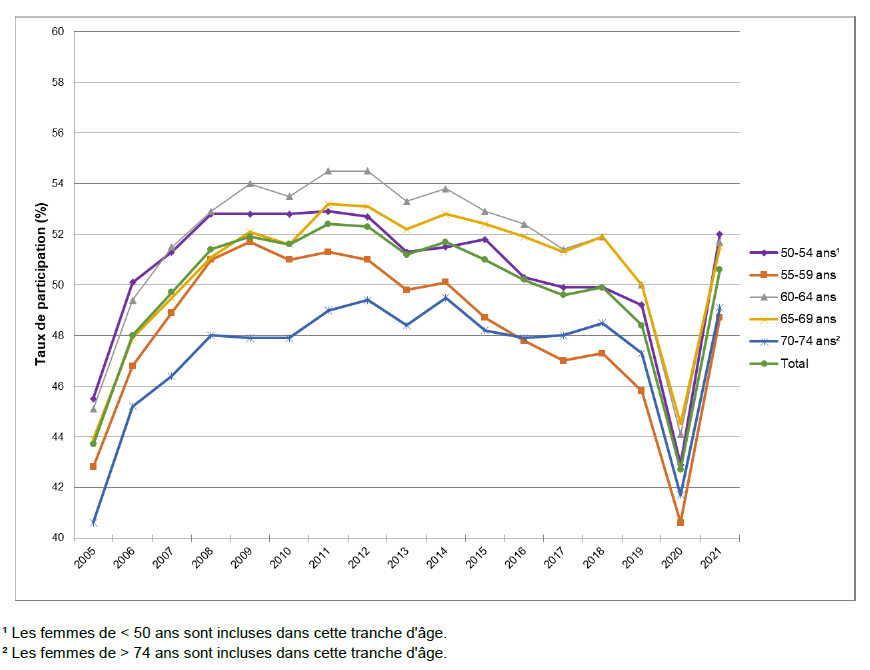
In 2021, 2.7 million women underwent an organized screening mammogram, corresponding to a national participation rate of 50.6% (versus 42.6% in 2020). While participation in 2021 partially made up for the shortfall in 2020 caused by the COVID-19 pandemic and lockdowns, participation for the 2020–2021 period (46.6%) remains lower than that of the 2018–2019 period (49.1%) across all age groups, all metropolitan regions, and nearly all departments. Indeed, since women are encouraged to undergo screening every two years, the data must be examined over rolling two-year periods.
COVID-19 likely continued to disrupt breast cancer screening in 2021, but the overall decline in screening observed since 2012 across all age groups and regions may be continuing. Other possible explanations include the impact of the controversy over the benefits and risks of breast cancer screening, the decline in breast care services leading to difficulties in performing mammograms, and the increase in the time between screenings.
It should be noted that organized screening represents only a portion of screening practices in France, and some women undergo screening outside of the recommended guidelines.
Learn more

données
Participation rates in the organized breast cancer screening program for 2021–2022 and trends since 2005
Trends in Participation Rates in Organized Breast Cancer Screening, by Age - 2005–2021
Regional disparities have been observed, with very low participation in the Île-de-France region and the Southeast
Voter turnout for the 2020–2021 period ranged from 21.4% in French Guiana to 53.6% in the Centre-Val de Loire region. The same geographic pattern is observed as in previous periods, with the highest participation rates ranging from Brittany to the Rhône-Alpes region, and very low participation in the Île-de-France region (36.7%) and the Southeast (36.1% in PACA).
In 2021, participation by department ranged from 29.2% in French Guiana to 65.7% in Savoie. For the 2020–2021 period, it ranged from 21.4% in French Guiana to 58.0% in Côte-d’Or and Indre-et-Loire.
Reduce risk factors with our prevention tools
Several resources available to everyone have been established by Santé publique France. Understanding health issues, reducing risks, changing behaviors… find all the information and tools in our dedicated resources and websites regarding:
smoking, particularly via the tabac-info-service.fr website
alcohol consumption, notably via the site alcool-info-service.fr
sedentary lifestyles and obesity, notably via the mangerbouger.fr website
What are Santé publique France’s responsibilities regarding the monitoring and evaluation of the organized breast cancer screening program?
participate in the epidemiological surveillance of breast cancer
Evaluating the performance of the national organized breast cancer screening program
Evaluate the impact of screening on breast cancer mortality and morbidity
promote efforts to combat preventable risk factors
Odysseus
Santé publique France's open data portal, based on its 70 surveillance systems, surveys, and scientific expertise.












