


Ebola Virus Disease Outbreak in the Democratic Republic of the Congo. Update as of August 19, 2019.
On July 17, 2019, the WHO Emergency Committee declared that the Ebola virus disease (EVD) outbreak then affecting the provinces of Ituri and North Kivu in the Democratic Republic of the Congo (DRC) constituted a Public Health Emergency of International Concern (PHEIC) under the International Health Regulations.
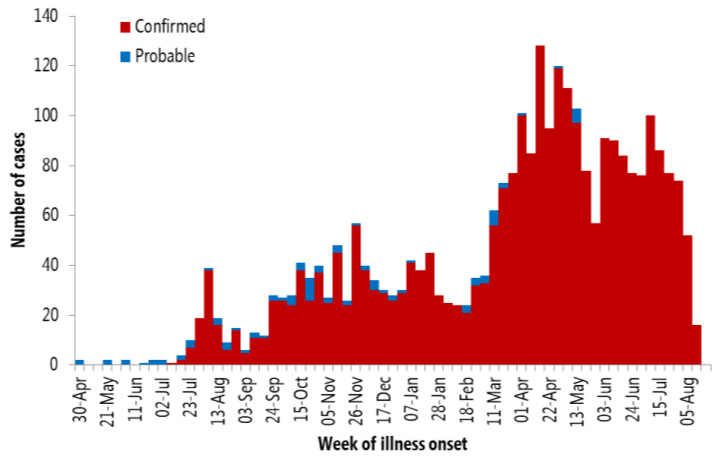
Initially declared on August 1, 2018, in the Mabalako health zone (North Kivu province) by the DRC Ministry of Health, this outbreak had, as of August 19, 2019, 2,909 cases, including 1,953 deaths (Figure 1). One hundred fifty-four cases occurred among healthcare workers who were infected while caring for patients (data as of August 17, 2019). It has been retrospectively estimated that the current outbreak began in May 2018. As of August 15, 2019, the first case was confirmed in South Kivu Province, Mwenga health zone, linked to an outbreak in Beni, North Kivu.
The WHO does not recommend any restrictions on travel or trade with the DRC. The WHO’s risk assessment indicates a high risk of national and regional spread, but a low risk of spread beyond the region. This risk remains very low for the European Union and France, according to the European Centre for Disease Prevention and Control (ECDC).
Figure 1: Number of cases per week of symptom onset, Ebola virus disease outbreak, Democratic Republic of the Congo, May 2018–August 2019
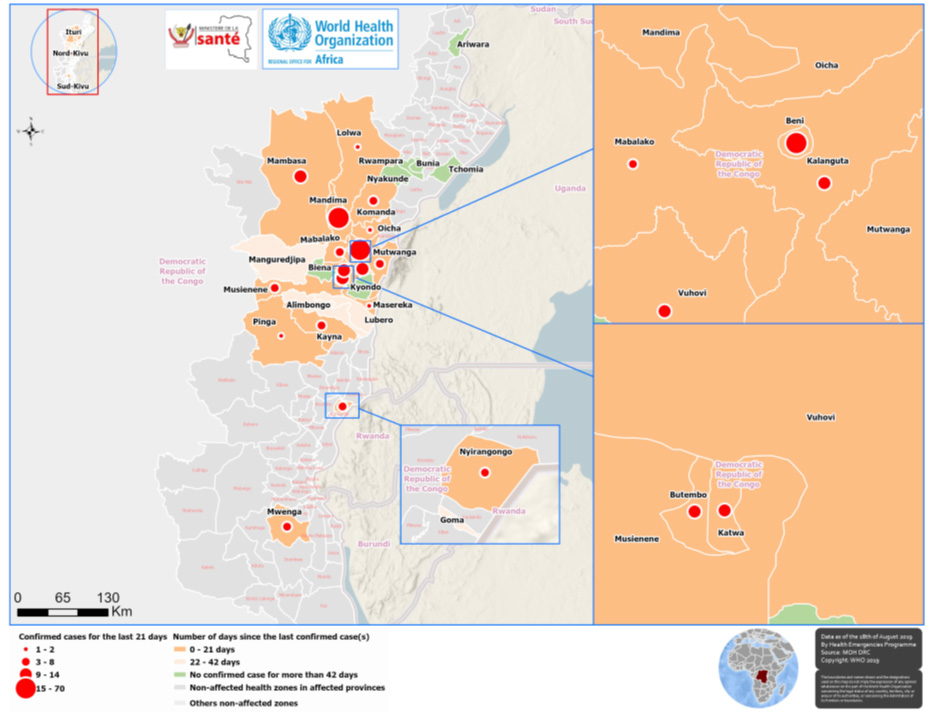
Since the start of the outbreak, cases have now been reported in three provinces: North Kivu, Ituri, and South Kivu (Figure 2). The affected health zones are as follows:
North Kivu: Alimbongo, Beni, Biena, Butembo, Kalunguta, Katwa, Kayna, Kyondo, Lubero, Mabalako, Manguredjipa, Masereka, Musienene, Mutwanga, Oicha Vuhovi, and most recently Goma (3 cases, including one case of local transmission);
Ituri: Ariwara, Bunia, Nyankunde, Komanda, Lolwa, Mambasa, Mandima, Rwampara, and Tchomia;
South Kivu: Mwenga.
The affected areas are located several thousand kilometers east of the capital, Kinshasa, near the borders with Burundi, Rwanda, Uganda, and South Sudan. To date, no local transmission chains of EVD have been reported in countries neighboring the affected area, despite the importation into Uganda of three cases infected in the DRC.
This is the 10th EVD outbreak affecting the DRC. Analysis of the virus’s genome shows no link between this outbreak and another that occurred in the DRC in 2018 in a different province of the country.
The DRC Ministry of Health, the WHO, and numerous international partners are collaborating on the ground to control the outbreak.
Figure 2: Geographic distribution of EVD cases in the Democratic Republic of the Congo as of August 19, 2019
For more information on the latest developments in the pandemic:
To learn more about Ebola surveillance and diagnostic procedures in France:
Ebola Virus Disease Information
Report on Notifiable Diseases












