


Epidemiological Situation of Acute Gastroenteritis in France. Update as of April 2, 2013
Monitoring of Acute Diarrhea Cases by the Sentinelles Network
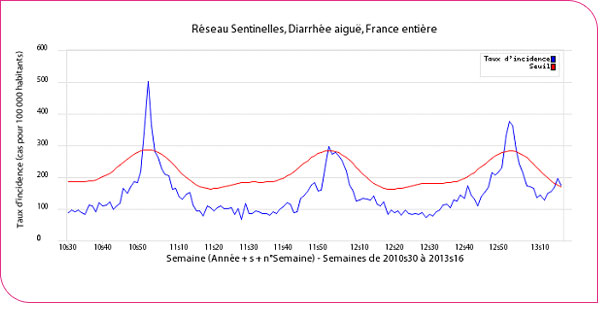
For week 13, March 25–31, 2013, according to unconsolidated data from the Sentinelles Network (http://www.sentiweb.fr/), the national incidence of acute diarrhea leading to a visit to a general practitioner was 209 cases per 100,000 inhabitants, above the epidemic threshold of 190 cases per 100,000 inhabitants (Figure 1). Nine regions have an incidence rate above the national epidemic threshold: Limousin, Nord-Pas-de-Calais, Alsace, Lower Normandy, Provence-Alpes-Côte d’Azur, Upper Normandy, Languedoc-Roussillon, Lorraine, and Aquitaine.
Figure 1
National incidence rate (cases per 100,000 population) of acute diarrhea and epidemic threshold, September 2010–January 2013, data from the Sentinelles Network as of April 2, 2013
Surveillance of Gastroenteritis Using OSCOUR® Data from Hospital Emergency Departments
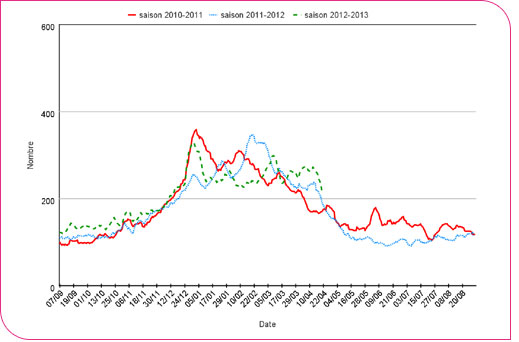
Hospital emergency department activity for acute gastroenteritis (AGE) has decreased slightly and is comparable to that observed during the same period in the previous two years (Figure 2).
Figure 2
Daily emergency department visits for acute gastroenteritis in metropolitan hospitals participating in the surveillance program, winters of 2010–2011, 2011–2012, and 2012–2013 (7-day moving averages) – Hospitals (constant)
Clusters of viral gastroenteritis reported to the InVS
Since the beginning of week 44 (October 29, 2012), samples have been received at the CNR for enteric viruses from 298 of the 306 gastroenteritis outbreaks reported to the CNR, the vast majority of which originated in nursing homes. A norovirus has been identified in 255 of the 274 outbreaks for which definitive virological results are available at the CNR. The emergence of a new GII4 genotype variant for this season has been reported by the CNR for Enteric Viruses, and this virus is implicated in more than three-quarters of the clusters of norovirus-associated gastroenteritis.
This new variant, Sydney 2012, was recently the subject of two publications in Eurosurveillance (http://eurosurveillance.org/ViewArticle.aspx?ArticleId=20345 and http://eurosurveillance.org/ViewArticle.aspx?ArticleId=20413).
New variants of norovirus GII4 emerge every 2 to 3 years and may be associated with larger-scale outbreaks.
Conclusion
The number of emergency department visits for gastroenteritis (Oscour network) has decreased compared to last week.
The number of gastroenteritis consultations in private practice observed by the Sentinelles Network is increasing among younger children (unconsolidated data), which may be linked to the resurgence of rotavirus infections during this period, as observed by the CNR.












